Low Calories, Low Alcohol Wines – Second Encounter
About a year ago, I tried for the first time the wine deliberately produced to be in the “low calorie, low alcohol” category – you can find the story here. You might want to refer to that article as I made an effort there to explain how calories are calculated in wine, which I’m not planning to repeat today.
Back in April, I was offered to taste two of the low-calorie, low-alcohol wines – and this is where the story started. To put things in perspective – the “low calories, low alcohol” Pinot Noir I tasted a year ago had 124 calories per standard glass – versus 154 calories in the glass of full-bodied Cabernet Sauvignon – with 30 calories difference, you make your own conclusions. To be clear, I relegate the “low calories” sentiment to pure marketing – therefore when I got an email with an offer to review two low-calorie wines, my first inclination was to respectfully decline. Also, the wine labels in the picture had a clear message depicted with the standout letters LO CA – I attributed CA to California which was also kind of a letdown as I prefer Californian wines to be unmanipulated.
After skimming (sic!) through the email I wrote back a reply (tirade, rather) explaining how I would only write about wines if I like them, and I wouldn’t write about them if I don’t like them – of course, this was obvious, but nevertheless, I decided for some reason to stress it and then agreed to try the wines.
A few days later I got the wines and then it was time to taste them. I took pictures of the bottles and studied the labels of the wines I was about to open. The wines are from California, so it is given that the white wine is Chardonnay, and the red should be Cabernet Sauvignon… Malbec? Why does it say Malbec? Malbec from California? What an unusual choice for the low-calorie wine!
oohhh…
Why does it say “Argentina” on the label?
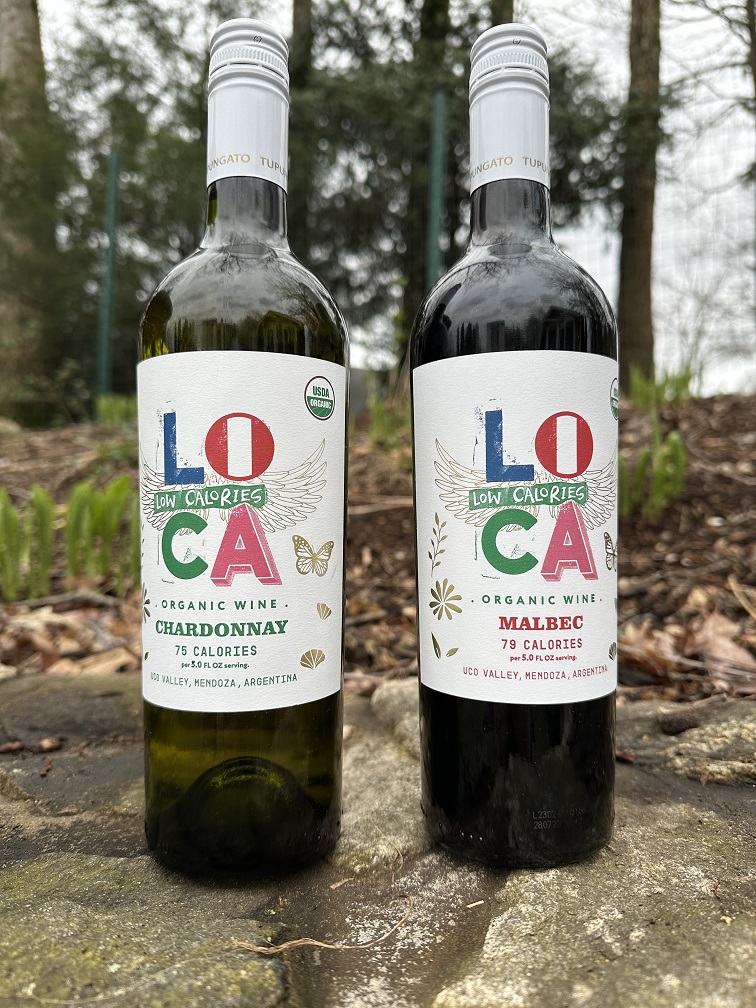
Ah, the wines are from Argentina! LO CA simply stands for LOw CAlories, that CA has nothing to do with California (also “loca” means “crazy” in Spanish, but this is probably unrelated?). And the wines are produced not by some unknown little winery but by Domaine Bousquet, possibly the best organic wine producer from Argentina and one of my favorite producers overall as so far I haven’t had a bottle of wine from Domaine Bousquet that I didn’t like. And now I feel embarrassed.
Remember I told you that I skimmed through the email instead of actually reading it (horrible habit, I know)? If would carefully read the email this embarrassing situation would’ve been avoided, as I would just gladly accept the wines from Domaine Bousquet – I quickly rushed to write an apologetic email explaining my error in judgment.
From here on I was a lot more encouraged to taste the wines, and now was really looking forward to the first sip.
In almost 35 years of its existence (while vacationing in Argentina, Frenchman Jean Bousquet purchased 1,000 acres of arid desert in Gualtallary Valley in Uco Valley in 1990, the beginning), the folks at Domaine Bousquet accomplished truly a lot – a lot more than thousands and thousands of other wineries accomplished in their lifetime. Domaine Bousquet produces 4 million liters (the equivalent of 5.3 million bottles) of wine 95% of which is exported to 50 countries. More importantly, the winery started practicing organic viticulture in 1997, and today it is USDA-certified organic, Ecocert-approved, and Regenerative Organic Certified™. To make sure you can fully appreciate it, there are only 21 regenerative organic certified wineries in the world at the moment of this writing and Domaine Bousquet was the first winery in Argentina to obtain this certification.
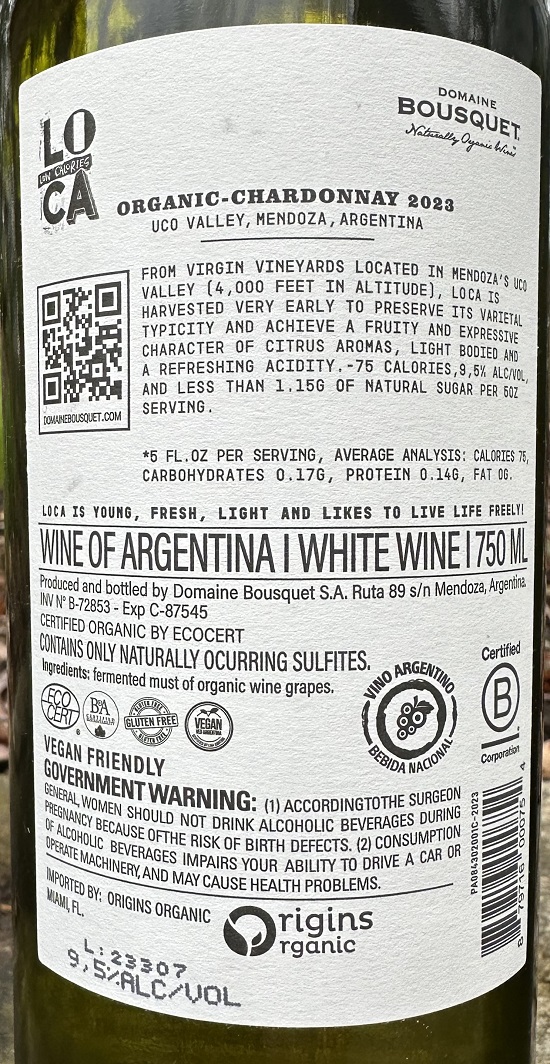 How do you make your wines low calorie, low alcohol without any manipulation? I didn’t think of it, but as I started working on this post I had to read a bit about the wines I was tasting, and it appears that it is easy 😀you just harvest early.
Here is the information from the winery notes for these two wines:
“Grapes were harvested in the early summer, between late January and early February, about two months earlier than for standard bottlings. To guarantee optimum quality, different parcels were picked at different times. The grapes were then fermented in stainless steel tanks for 12-17 days. Bottling followed shortly after to ensure peak freshness, preserve its varietal typicity, and achieve a fruity and expressive character.”
Now, the culmination point – my impressions after tasting the wines.
2023 Domaine Bouquet LO CA USDA Organic Chardonnay Uco Valley (9.5% ABV, $14, Residual Sugar: 1,21; Acidity / PH: 7.72/3.21; 75 Calories):
This was an interesting experience. The nose was muted, and on the palate, there was still not much except the acidity. The wine had nothing but the acidity. Dont’ get me wrong – it was drinkable, but it was truly competing with Muscadet for the title of “Best oyster wine”. I would be more receptive to this wine if the label wouldn’t say Chardonnay, but instead simply said “white wine”, as I have certain varietal expectations for Chardonnay wines. Over the next few days, the wine continued to be drinkable and complexity increased a bit, but still the acidity was the key element.
Verdict: Food wine. I would love it with oysters, and I’m sure you would too. You can probably have a glass on its own on a hot summer day, but better have the food ready.
2023 Domaine Bouquet LO CA USDA Organic Malbec Uco Valley (9.5% ABV, $14, Residual Sugar: 1,21; Acidity / PH: 5.62/3.62; 79 Calories)
This wine was even more interesting than the Chardonnay. Beautiful ruby color. Nose of the fresh, just harvested wild berries, delightful. The palate offered the same berry medley, fresh wild berries all the way but without structural support, and of course acidity driven. This wine reminded me of how Beaujolais Nouveau was 10 years ago, just fresh berries and nothing else. The wine lasted for a few days, gaining a bit more complexity (a welcomed development). I wouldn’t say it is my wine, but if you are looking for a refreshing wine for a hot summer day, this might do it. And I only realized now, when I’m writing this, that I should’ve chilled the wine and it probably would make it more interesting.
Verdict: It is drinkable, and if you are really looking to cut some calories, this might be the wine you need – just don’t overdo it, because an extra glass with low calories will instantly negate all your “low-calorie” achievements. Serve chilled.
Here you go, my friends. Two organic wines, low calorie, low alcohol – perfect to serve at your next summer party. Just have the food ready.
Last Bottle Sign Up ($10 credit)




 Talk-A-Vino