Archive
Study of Grapes, 152 at a Time
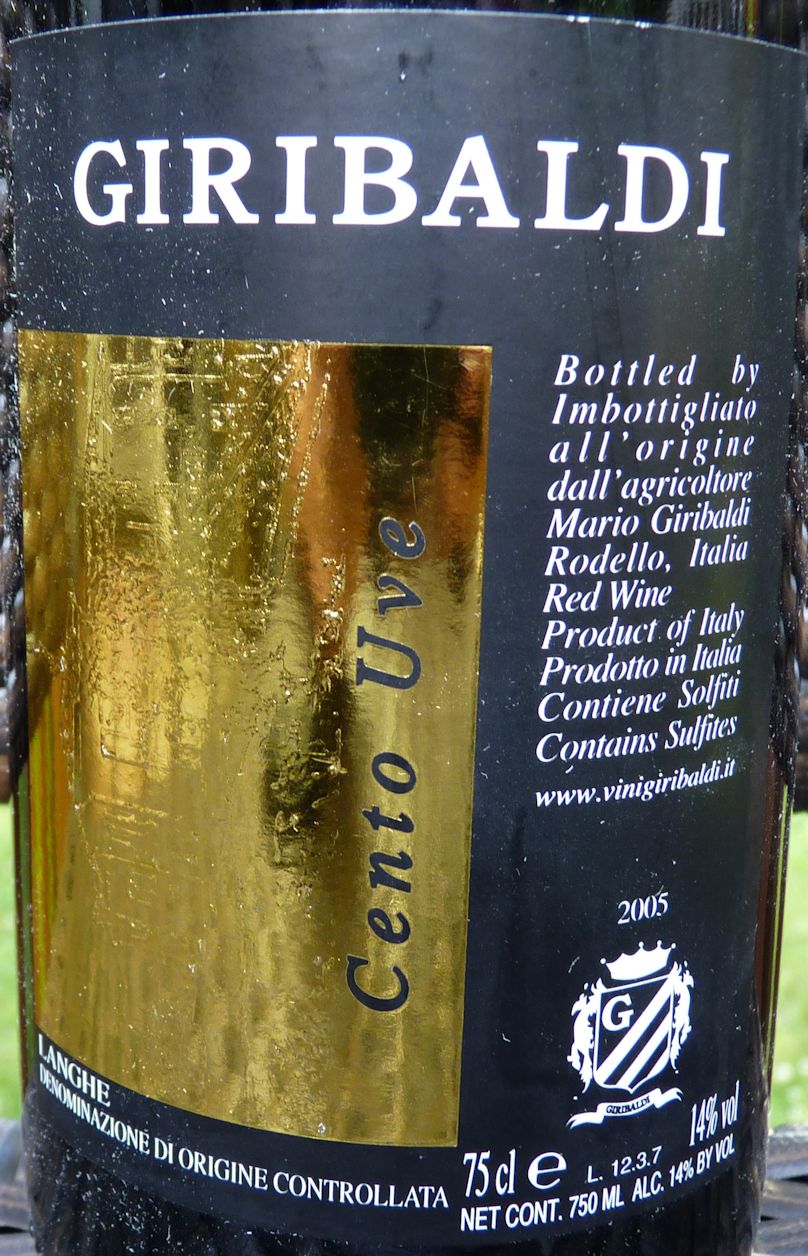 How do you experience 152 grape varieties, all at the same time? Easy. You get a bottle of Giribaldi Cento Uve wine and … voilà!
As you probably know, I’m an enthusiastic member of the Wine Century Club – a virtual club dedicated to the grape adventures. I already talked too many times about virtues of the Wine Century Club, thus I’m not going to bore you with those details again. Instead, let me focus on only one, dare I say it, sacred bottle of wine – 2005 Giribaldi Cento Uve Langhe DOC.
What makes this wine “sacred”? It is made out of 50% Nebbiolo and the other 50% containing additional 151 (!) varieties, so it can really help you to advance in the quest for higher levels of The Wine Century Club membership (except that it doesn’t count towards the first level of membership with 100 varieties). The wine is almost impossible to find in US – except one wine shop in Colorado which actually carries it (if you are interested, the wine is available from The Vineyard Wine Shop, 303-355-8324). When I called the store to order this wine, gentleman who answered the phone, Matt, said that he is quite convinced that they don’t have any wine under such name – after checking his computer, he was surprised more than me by actually finding it. At $60 + $20 for the shipping, this was definitely worth the experience.
Interestingly enough, finding this wine and drinking it was the easiest part – the tough (seriously tough) part was figuring out what grapes I already tasted and what grapes I can actually add to my list. As this is one of the coolest parts of Wine Century Club membership ( figuring out what is what in the grape world), let me explain it with appropriate level of details.
To begin with, the web site for this wine states that it contains 152 varieties. The list of grapes is nowhere to be found on the winemaker’s web site. The only place on internet where you can find the list is at the Indian Wine Academy. Well, list is a list, you say, right? Yes, but not precisely. As I need to properly account for all the grapes I already tasted, I need to go through that list very carefully, line by line. As soon as I started going through the list, I noticed duplications (same grapes listed twice, like Gamay, for instance) – I called it a red flag and decided that the right thing to do is to contact Giribaldi, the winemaker. After 2 or 3 of my e-mails went unanswered, I decided that it is a time to … get an audience support? No, call a friend! And as I happened to have a good friend in Italy, Corrado, I asked him to help me to get to the correct list. This was not easy, but after a few conversations with the winery, he was able to get full description of the wine, including the list of grapes.
Yay? Nope. The list of grapes was … identical to the one published on the site of the Indian Wine Academy! Fine. From here on, I had to figure it out myself. I converted the list to the Excel file, and sorted it alphabetically. Then I had to figure out how to get from 156 varieties listed to the 152 which we know this wine has. It later downed on me that 156 varieties include Nebbiolo and 4 Nebbiolo clones , therefore if we will take all 5 Nebbiolo varieties from consideration we will get to the target number of 151. Whew. Tired of me yet? No? Let’s continue.
Next step was to remove obvious duplicates, then go through the list again. For every grape I didn’t know, I used Internet resources to verify that such a grape exists (i.e., referenced at least once on one or more sites). Here is the good list of references in case you ever need to conduct a search on grape etymology (Italian grapes, if you will):
After all the cleanup, removing duplicates, fixing the spelling and checking the references, I got to the final list of 138 grapes (don’t ask me where the 14 went – let’s keep it a grape mystery), out of which I was unable to find any references for the grape called Michele Pagliari – therefore I’m keeping it on the list, but not counting towards the new grapes. In case you want to see a transition here is an excel file for you – note that is has multiple spreadsheets inside starting from full list. Here is the list of those final 138 grapes.
Legend: letter N next to the grape stands for Nero (red), B is for Bianche (white), Rs is for Rose. Showing in Bold are the grapes which I count as new grapes for my grape count.
| Aglianico N | Michele Pagliari N |
| Albarola N | Montepulciano N |
| Albarossa N | Moscato bianco B |
| Aleatico N. | Moscato giallo B |
| Alicante Bouschet N | Moscato nero di Acqui N |
| Ancellotta N. | Moscato Rosa Rs |
| Arneis B | Muller Thurgau B |
| Avanà N | Nascetta B |
| Avarengo N | Nebbiolo N. |
| Baco Nero N | Nebbiolo ( Bolla) N |
| Barbera bianca B. | Nebbiolo ( Rosè) N |
| Barbera N. | Nebbiolo (Lampia) N |
| Becuet N. | Nebbiolo (Michet)N |
| Bianchetta Tevigiano B | Negrette N |
| Bianchetta Veronese B | Neretta cuneese N. |
| Bombino Bianco B | Neretto di Bairo N |
| Bombino Nero N | Nero Buono N |
| Bonarda Piemontese N | Nero d’Ala N |
| Bosco Nero N | Nero d’Avola N |
| Brachetto N. | Neyret N |
| Bracciola N | Pampanuto N |
| Brunello N | Pecorino N |
| Bussanello B | Pelaverga (di Pagno) N |
| Cabernet Franc N | Pelaverga N |
| Cabernet Sauvignon N | Pelaverga piccolo N |
| Canaiolo B. | Petit Arvine N |
| Canina N | Petit Verdot N |
| Cannonau N | Pigato B |
| Carica l’Asino N | Pignola Nera N |
| Carignano N | Pinot bianco B |
| Catarratto comune B | Pinot Grigio G |
| Catarratto Nero N | Pinot Nero N |
| Chardonnay B. | Plassa N |
| Chatus N | Pollera 1 N |
| Ciliegiolo N. | Portugieser N |
| Colorino Nero N | Primitivo N |
| Cornalin | Prosecco B |
| Cornarea N | Quagliano N |
| Cortese B | Raboso Veronese N |
| Corvina Nera N | Rebo Nero N |
| Croatina N | Refosco da Peduncolo Rosso N |
| Crovassa N | Riesling B |
| Dolcetto N | Riesling italico B |
| Doux d’Henry N | Riesling Renano B |
| Durasa N | Rossese bianco B |
| Durasca (Dolcetto di Boca) N | Rossese N |
| Enantio N | Ruché N |
| Erbaluce B | Sangiovese N |
| Favorita B | Sauvignon Blanc B |
| Franconia N (Blaufränkisch) | Schiava Gentile N |
| Freisa di Chieri N | Schiava grossa N |
| Freisa di Nizza N | Schiava N |
| Gamay N. | Sylvaner Verde B |
| Gargiulo N | Syrah N |
| Grechetto N | Teroldego Nero N |
| Grignolino N | Timorasso B |
| Grillo B | Tocai Friulano B |
| Incrocio Manzoni N | Tocai Rosso N |
| Lambrusca di Alessandria N | Torbato B |
| Lambrusco Maestri N | Traminer aromatico Rs |
| Lumassina N | Trebbiano Toscano B |
| Maiolica N | Uva di Troia N |
| Malvasia di Casorzo N | Uva rara N |
| Malvasia di Schierano N | Uvalino N |
| Malvasia Istriana N | Veltlimer Fruhrot N |
| Malvasia nera lunga N | Verduzzo Trevigiano B |
| Manzoni bianco B | Vermentino B |
| Marzemino N | Vespolina N |
| Merlot N | Zweigelt N |
And A Few Words, Errr – Whiskys for The National Scotch Day
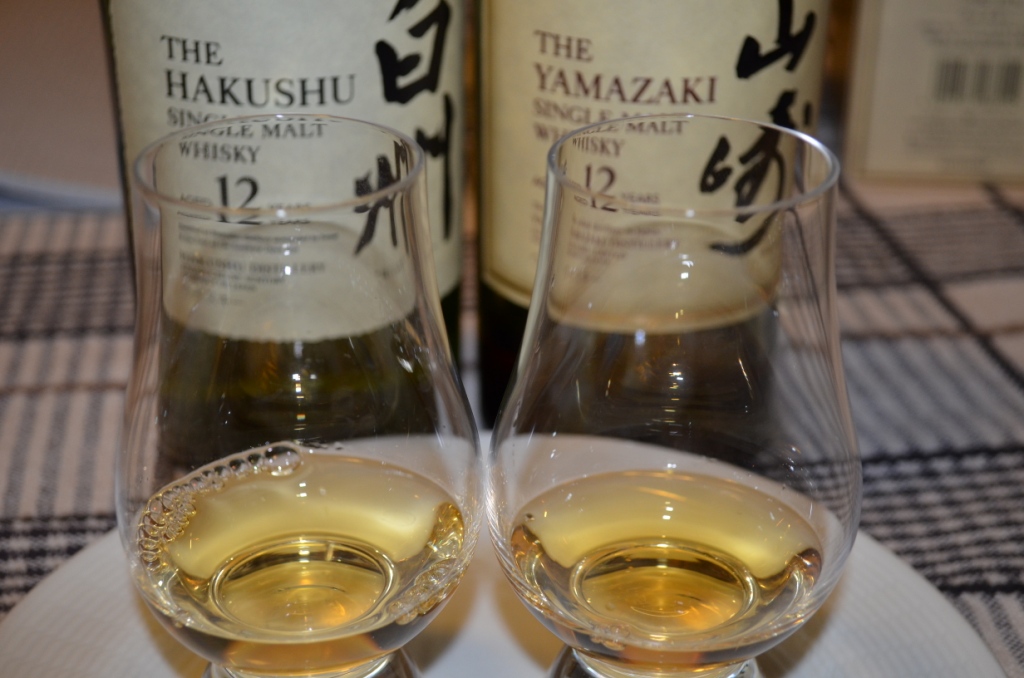 While you are not going to see it well marked in many calendars, July 27th was the National Scotch Day. Actually, if you like Scotch, you should definitely mark it in your calendar for good going forward- unlike some other wine holidays, it always takes place on July 27th – or it seems to be so, as I was unable to trace the origin of this holiday. There is enough references in various blogs mentioning the July 27th as National Scotch Day, so let’s just go with the flow.
Having more holidays is always better, especially when you get an opportunity to celebrate such a distinguished drink as Scotch. And the better word to use is Whisky, as all the Scotch is Whisky, but not all the Whisky is Scotch (and then you got much bigger world of Whiskey- one little letter “e” makes a world of difference – but let’s keep focus on the Scotch for now).
To celebrate in style, I decided to compare two whiskys, both made in Japan by the company called Suntory. Currently, Suntory makes three different lines of whiskys – Yamazaki, Hakushu and Hibiki, with the first two being single malts and the last one being a blend.
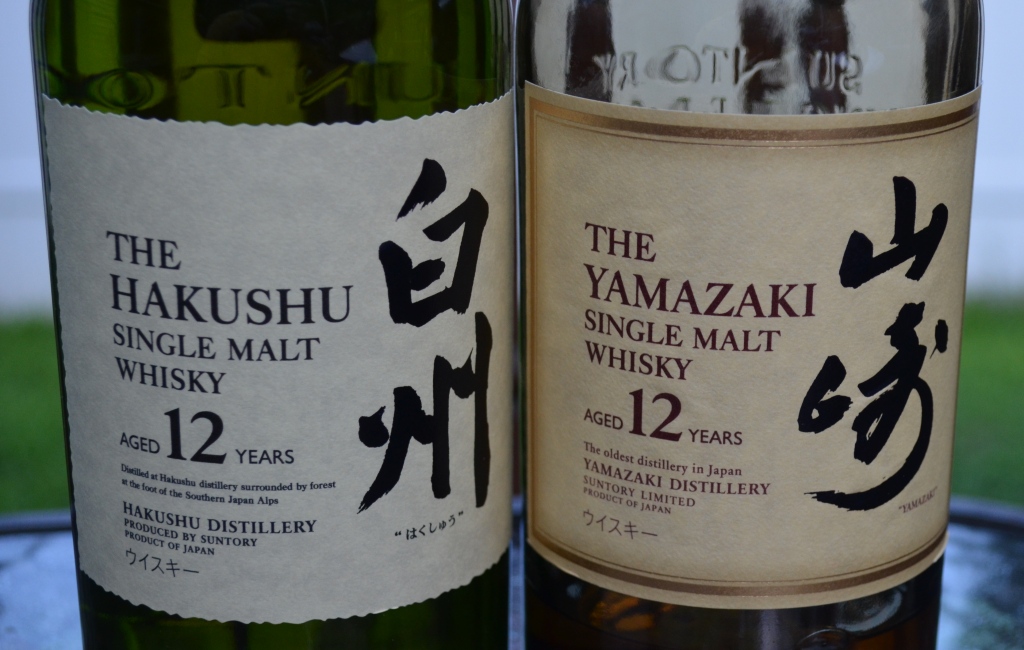
Yamazaki was one of my favorites for a while, but this was the first time I tried Hakushu (my brother in law brought it directly from Japan).
I started with Hakushu 12, which comes from the distillery under the same name, located in the forest in Southern Japanese Alps. On the nose, it had a touch of sweet smoke and a bit of grassiness. On the palate, Hakushu had a touch of sweetness, some vanilla notes, super soft and delicate, velvety and round in the mouth, with grass undertones and hint of butterscotch. Aftertaste was very complex, and had almost numbing qualities.
Yamazaki whisky comes from the distillery under the same name, which was the first malt distillery in Japan, opened in 1924 in the outskirts of Kyoto. This Yamazaki 12 was very clean on the nose with a bit of floral notes, more mellow than the Hakushu – but then I had the bottle open for quite a while, so this might be the factor. Very clean and smooth on the palate with more sweetness than Hakushu, caramel apple undertones and clean finish with high acidity.
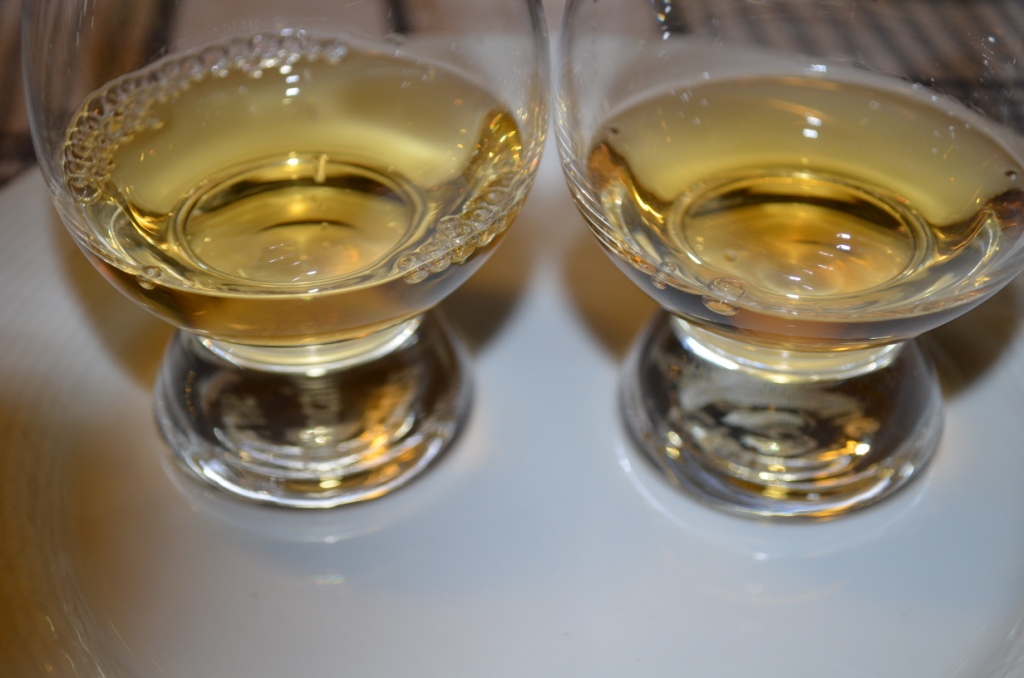 Oh yes, and in case you are wondering, I usually don’t add water to my scotch – with cask-strength sometimes being an exception.
Hakushu had higher complexity of the two, and Yamazaki showed lighter (both whiskys are labeled 43% ABV). If comparison might help, Hakushu was more of a Islay Scotch, similar to Lafroaig, and Yamazaki was much closer to Highland Scotches, similar to Glenlivet or Dalmore. I would highly recommend both Hakushu and Yamazaki – if you are into whisky, they are definitely worth looking for.
That’s all, folks. You don’t have to wait another year to celebrate Scotch – it is a great every day drink, without the need for any special reason to enjoy it. Cheers!
Weekly Wine Quiz #22: Olympics For All
XXX Olympic Games just opened with the beautiful ceremony in London, and for the next three weeks, the world will be cheering, screaming, crying and celebrating people willing to do more than their best. And of course, the world will continue eating and drinking.
At the moment, everything evolves around Olympics, and food and wine are no exception. Well, I don’t know if there is specially designated Olympic food – but wine – yes, there is.

Number of wines had been specially selected to be served during the Games. And truly in the spirit of the Games themselves, where 204 countries (I had no idea we even have that many on this little planet…) will be competing, some of the wines will be coming from quite unexpected places. The list below consists of lesser-known wine producing countries – and one of the wines you see above is coming from one of such countries. Do you know which country is that?
Have a great weekend! Cheers!
From Wine and Books To Wine In Books
 What do you take your wine with? There are few options, I guess. One (and most obvious) would be food. Another one would be a conversation (wine and conversation – a match made in heaven?). And then there is wine and the book – both get you in the mood, both complement and enhance each other and make the moment special (take your average week as an example – how many times per week you get to enjoy a quiet moment with book and the wine? What, zero? I hear you…).
Sometimes, wine even gets into the book – and I don’t mean by spilling it all over. Today is a Wine Blogging Wednesday #79, dedicated to Summer Reading, Summer Wine. The main question you are supposed to answer in your blog post is “What wine would your favorite fictional character drink?”.
I have two problem with this question – the same way as I can’t name my favorite wine, I can not name my favorite fictional character (there are many). And the second problem? Drinking wine (or any alcohol) is not necessarily a priority, no matter what the character is doing, therefore pinning it down is far from simple.
While I thought of a few different approaches ( including writing of the short essay about a character and the wine), advancing from thinking to the writing was not getting in sync with me. But then I thought of one of my all-times absolute favorite science fiction book. I can’t tell you how many times I read this book while I was growing up – 10, 20, 50 – I have no idea), but every time it was fresh and fascinating. This book was written in 1965 by two brothers, Arkady and Boris Strugatsky (originally in Russian), and it is called Monday Starts on Saturday. It is a science fiction (border line fantasy) book, talking about a research institute where wizards, sorcerers and just researchers work on exploring of the meaning of life (anyone who read the book in the original – I ask for your forgiveness for such a representation of this book). If anyone cares to read it in English, here the link to the full English text – however note that a lot of charm might be lost in translation.
So I decided to do a simple check for what kind of alcohol was mentioned in the book (using the word “bottle” as an anchor and remembering some of the key scenes). Here is the list:
- Wine (generic term, nothing specific)
- Champagne (again, nothing specific)
- Vodka (after all, this is a Russian book!)
- Cognac (with the perfect string attached: “A human might be just an intermediate element of evolution necessary to build a masterpiece of creation – a glass of cognac with slice of lemon” – note that translation is mine).
- Amontillado (pretty good, huh? This type of Jerez was mentioned by the name!)
- Elixir of Bliss (clearly a magical creation, but based on the personal experience, I would approximate it to an extremely old Pedro Ximenez Jerez)
Of course I might be missing something, but I like the list even as it is.
There you have it, my friends. My major point here? No matter what the characters are drinking, wine and books go perfectly hand in hand – hope you can find the time to enjoy both! Cheers!
Wednesday’s Meritage
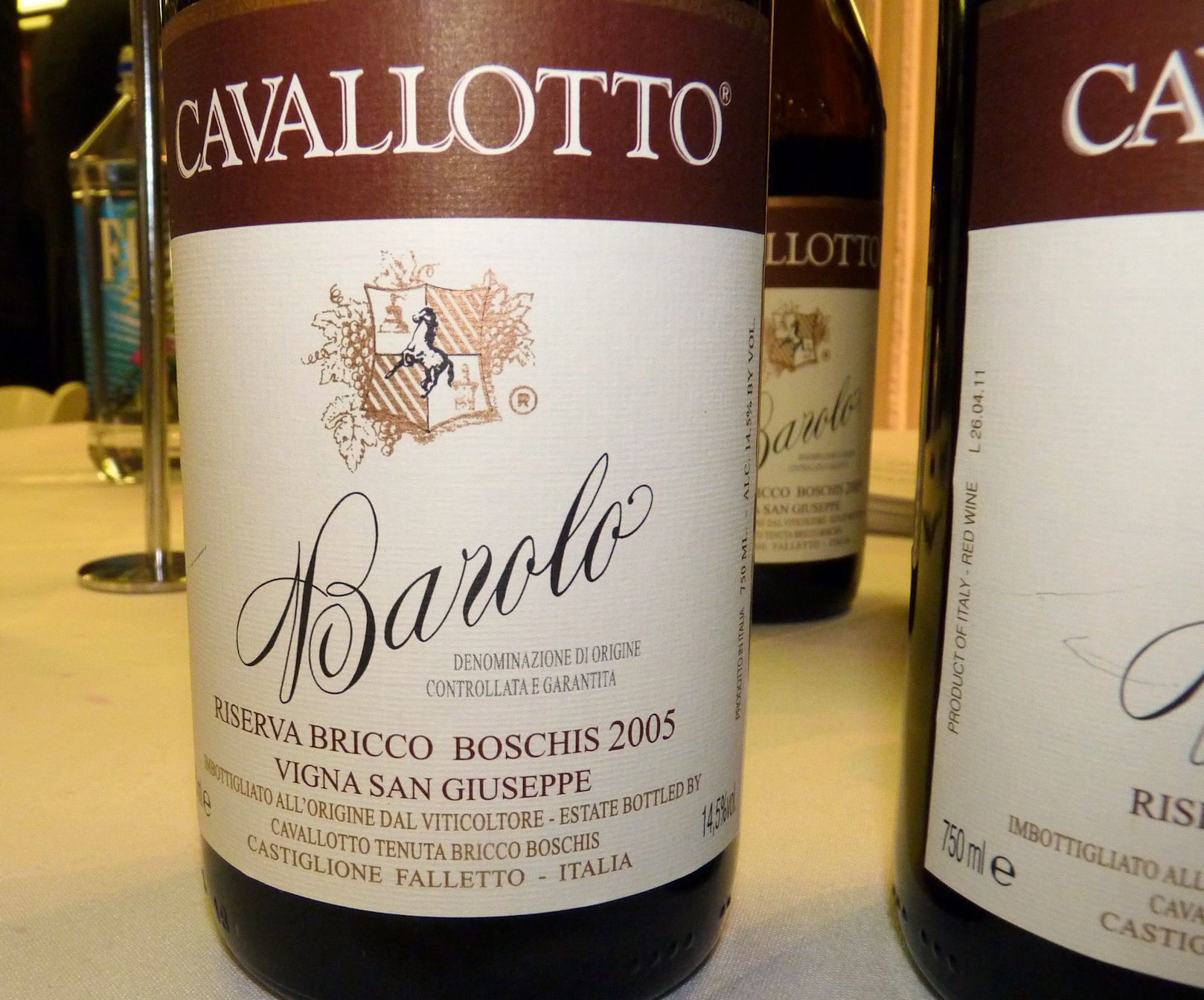 Hello and welcome to the special Wednesday – Wine Blogging Wednesday #79 it is, a.k.a. #WBW79.
Let’s start from the usual routine – the answer for the Wine Quiz #21 – Do you Know the King? Similar to the previous quiz, this one also had a diversity of opinion as to which wine is called a “King of the Wines”. And the answer is … Barolo!
Believe it or not, but until the middle of the 19th century Barolo was a sweet wine (it probably sounds funny for anyone who experienced the power of Barolo) due to the deficiencies of the winemaking process. In the second half of the 19th century, invited French oenologist managed to change the winemaking process which resulted in production of completely dry wine. This dry Barolo wine became so popular among nobility of Turin that it was often described as “the king of wine” (here is a link for you with more information on the subject). Now that you know the king, you can enjoy Barolo even more (but don’t forget to decant it!).
Now it is time for the wine news. Let’s start form the Wine Blogging Wednesday #79 – Summer Reading, Summer Wine. This is probably one of the more difficult WBW events, as you are required not to drink the wine yourself, but rather explain to the world what kind of wine your favorite fiction character should be drinking, and why. I’m still not decided if I will will be writing my blog post for #wbw79 – may be yes, may be no – but I’m sure it will be fun to read what the other people will have to say.
Now, all the wine lovers who like value – please pay special attention. Wine Till Sold Out (a.k.a. WTSO) Cheapskate Wednesday is coming up on August 8th. Starting at 6 am Eastern, deeply discounted wines will be offered for sale every 15 minutes or may be even faster. All the wines will be priced in the range of $7.99 to $18.99 and you will have to buy 4 bottles or more to get free shipping. These “marathon” events are usually offering great values and shouldn’t be missed – here are couple of reports (one and two) I compiled from the past events in case you want to have a frame of reference. Get your cellar ready!
Moving along. Next, I want to bring to your attention two more interesting posts. First, W. Blake Gray wrote about the results of market research of consumers’ emotional attachment to the brand (of course primarily concerning alcohol brands). This is pretty short post (here is the link) – read it, some of the results are staggering and hilarious at the same time.
Last but not least: if you love wine and live in a close proximity of Boston (remember, airplanes are known to greatly shorten the distances), there is a restaurant you must visit until the end of August. Why? Because this restaurant (Troquet) is offering mind boggling dealson superbly aged wines (1966 Bordeaux for $75? unreal…) – for more details, please read this post by Richard Auffrey who writes The Passionate Foodie blog.
That’s all for today, folks. Hope you enjoyed this Meritage, and don’t worry – the next Wednesday will be here much sooner than you are expecting, so we will be talking again. And… don’t forget to leave a comment. And – think about your #WBW79 post. Cheers!
Serious Fun With Wines
In case you are wondering about the “serious fun” versus “not so serious fun”, somehow this title just got stuck in my head when I thought about this post, and I decided not to fight that. Also, when you have Gaja, Ornellaia, Turley, Bertani and whole bunch of other interesting wines, I think “serious fun” is a good way to put it. And to stress even further how serious the fun was, I’m even using different style of pictures for this post instead of usual “just label” style (and yes, you are right, I also use an opportunity to play with my new camera).
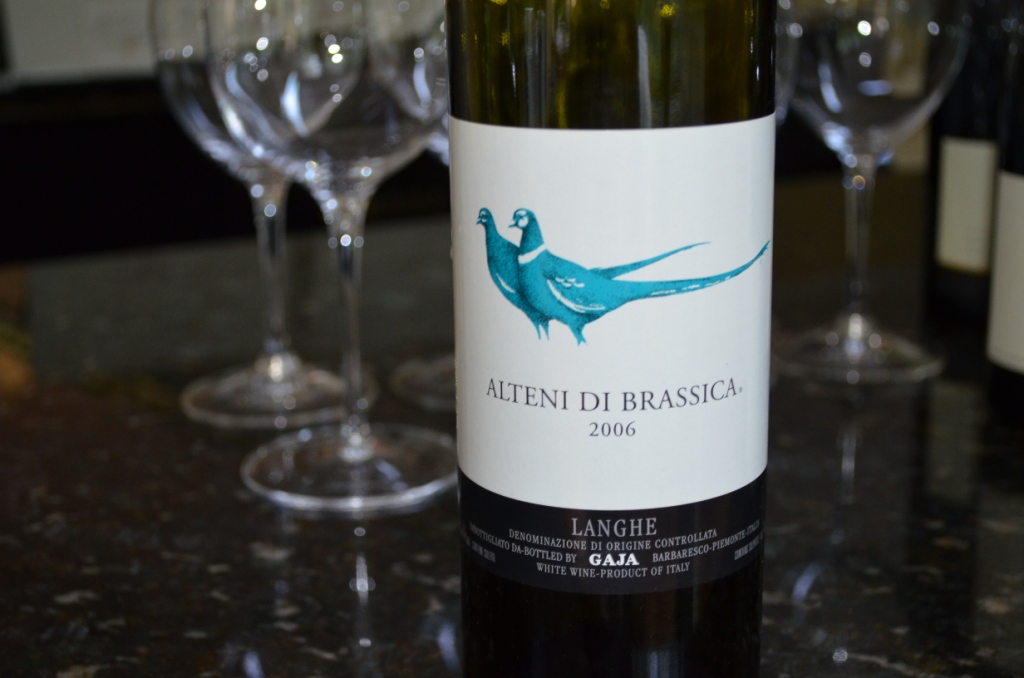
What is your first thought when you see the name like Gaja on the wine list? I don’t know about you, but in majority of the cases I would expect to see a red wine there. Yes, I can think of Gaja Chardonnay, and only because it typically looks at least as an affordable possibility on the wine list, as opposed to the Gaja red wines, which are not. So the wine we had was a white wine made out of …(wait for it)…Sauvignon Blanc!
2006 Gaja Alteni di Brassica Langhe DOC, Italy was a total surprise. Mineral nose, with wet stone, smoke and heavy grass. Touch of white fruit on the palate, more stone, touch of lemon, perfectly balanced. Finish lasted for 3 minutes, if not longer! Very beautiful wine. Drinkability: 9
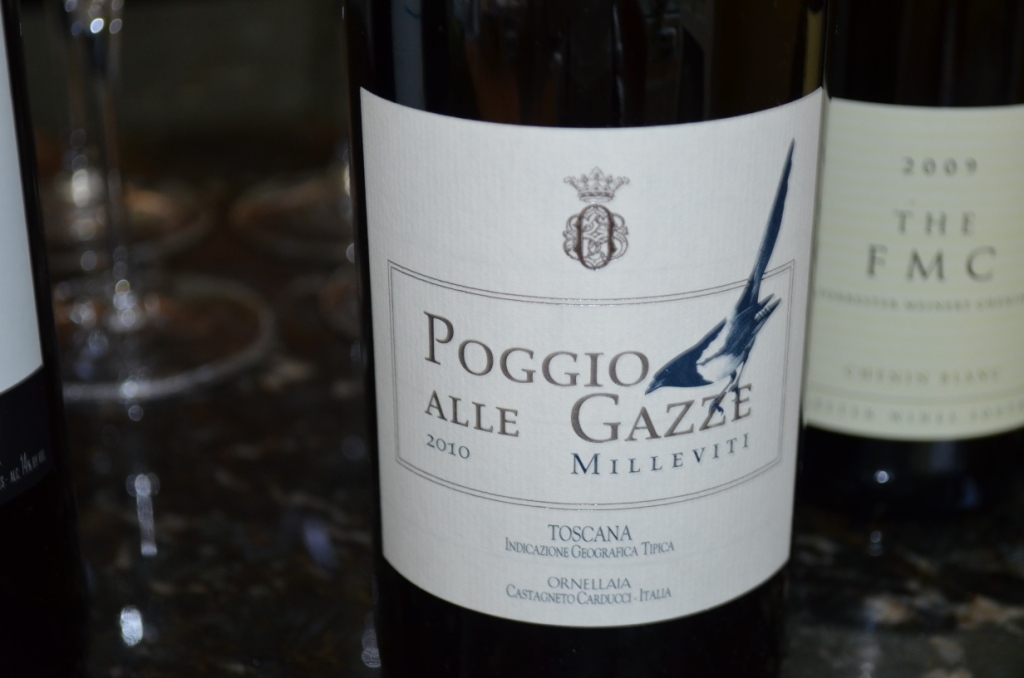
The next wine we had was also coming from a very respectful Italian producer, Tenuta dell’Ornellaia. And the wine was…yes, white again! The grape? Yep, Sauvignon Blanc. 2010 Poggio alle Gazze dell’Ornellaia, Toscana IGT was simply delicious, with perfumed nose of lychees and white apple. Palate was exhibiting nuts and ripe apple. Very long finish with some tropical fruit notes coming in later on. Bright, round, amazing! Drinkability: 9
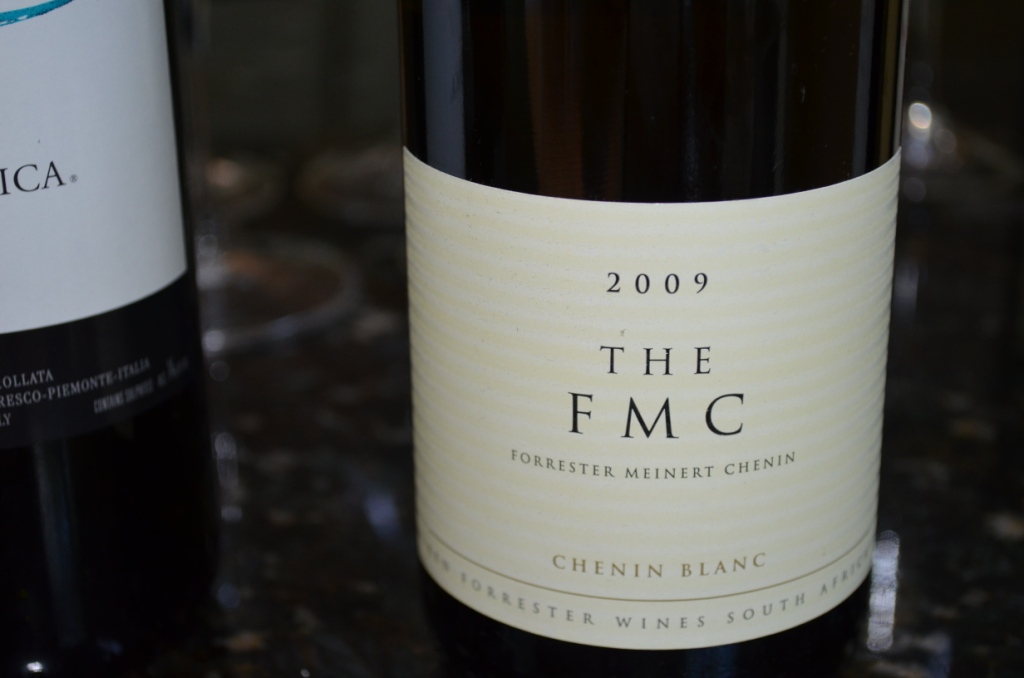
We continued our “whites’ extravaganza” with 2009 Ken Forrester The FMC ( (Forrester Meinert Chenin), South Africa. This wine was made out of the Chenin Blanc grape. While Chenin Blanc is one of the signature white French grapes from Loire, it also makes great wines around the world. It does particularly well in South Africa, where it is also known under the name Steen. This particular The FMC wine is a single vineyard flagship wine of Ken Forrester, one of the oldest producers in South Africa. This wine had a beautiful nose very similar to a typical chardonnay – nutty with some acidity, bright yellow color, very round. Drinkability: 8+

Done with whites. Before switching to the reds, we had a different, very unusual wine – as you can judge from the color above, this wine is not called “Orange” for nothing. Orange wine is one of the latest trends, where skin of the white grapes is left in the contact with juice during maceration. This imparts a nice deep yellow/orange color, hence the name, orange wine. This wine also was not some fly by night experimental plonk. 2008 Marani Satrapezo 10 kvevri, Georgia (100% Rkatsiteli grape, all coming from specific block of the Kondoli vineyard) was made in a traditional Georgian style with maceration for 20-25 days in historical clay vessel called Kvevri.
The wine had beautiful orange color. On the nose it had aromas of a bright fresh apricot. Palate was dry, full bodied, vegetative with enough brightness, touch of apricot but no sweetness whatsoever. After three hours in decanter the wine softened considerably – this wine definitely would benefit from a few years in the cellar. Drinkability: 8
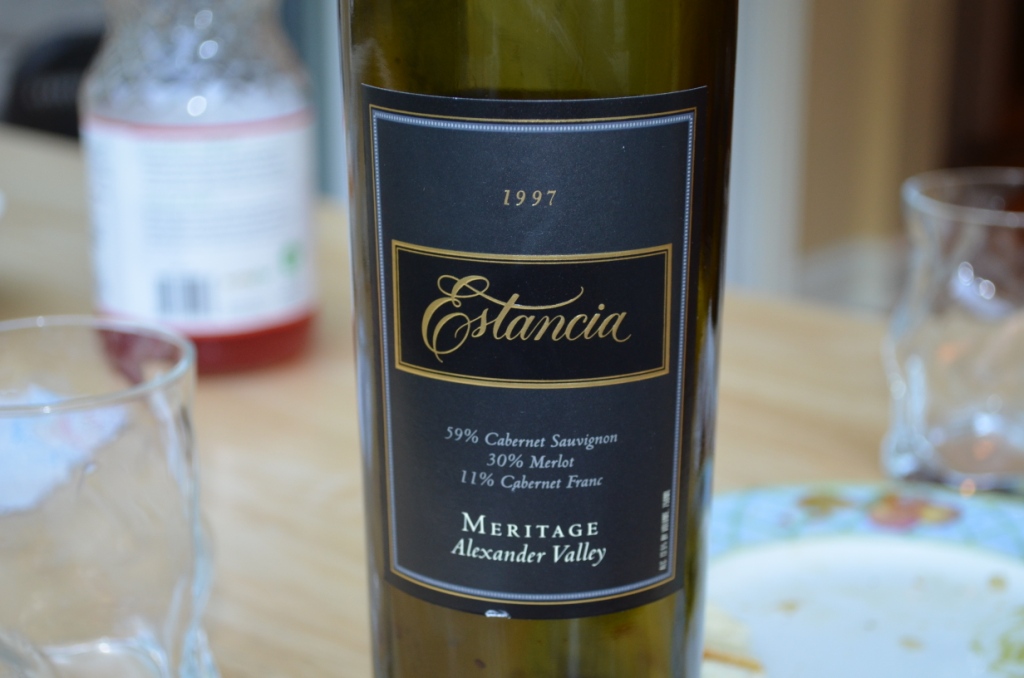 Okay, we are finally switching to reds – with it’s own set of surprises. We started from 1997 Estancia Meritage Alexander Valley (Cabernet Sauvignon/Merlot/Cabernet Franc blend). The wine had perfect color – dark, concentrated ruby red. Eucalyptus, wet stone, dust and raspberries on the nose. Bright red and black fruit on the palate with cassis, eucalyptus and licorice – perfect balance, nice, soft tannins. Drinkability: 8+
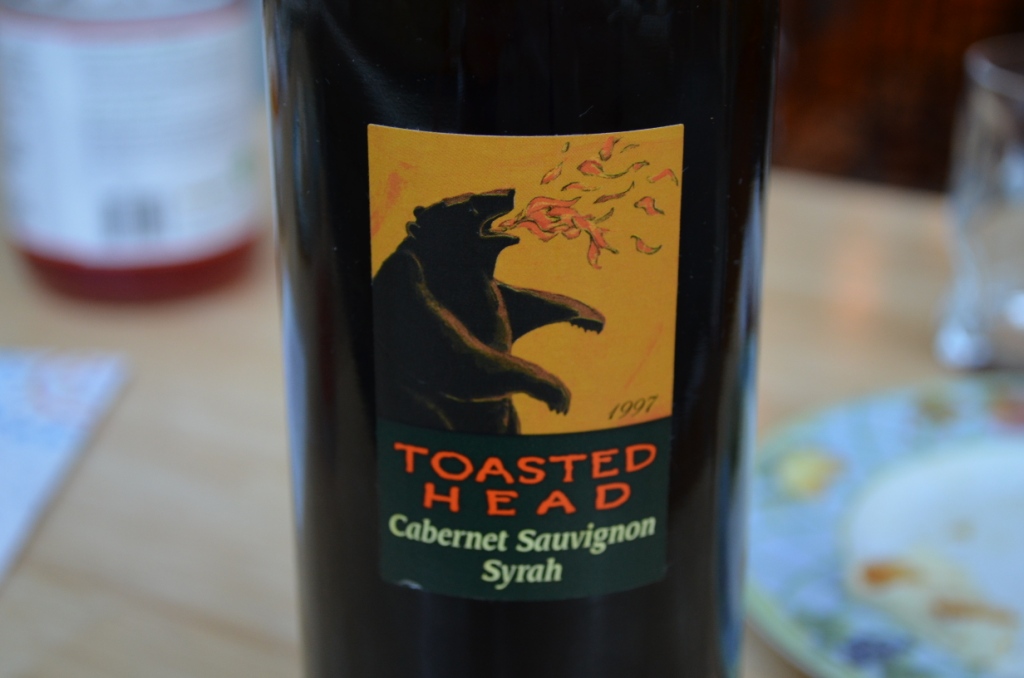 This was probably the biggest surprise of the evening – 1997 Toasted Head Cabernet Sauvignon Syrah California. Generally, Toasted Head makes simple everyday wines – which you generally are not going to age. This wine was simply lost in the cellar, and we opened it to taste but with the full readiness to dump it. To our astonishment (too strong of a word, but – why not), the wine had perfect acidity, bright youthful color, good black fruit, soft tannins and a touch of cassis. Drinkability: 8
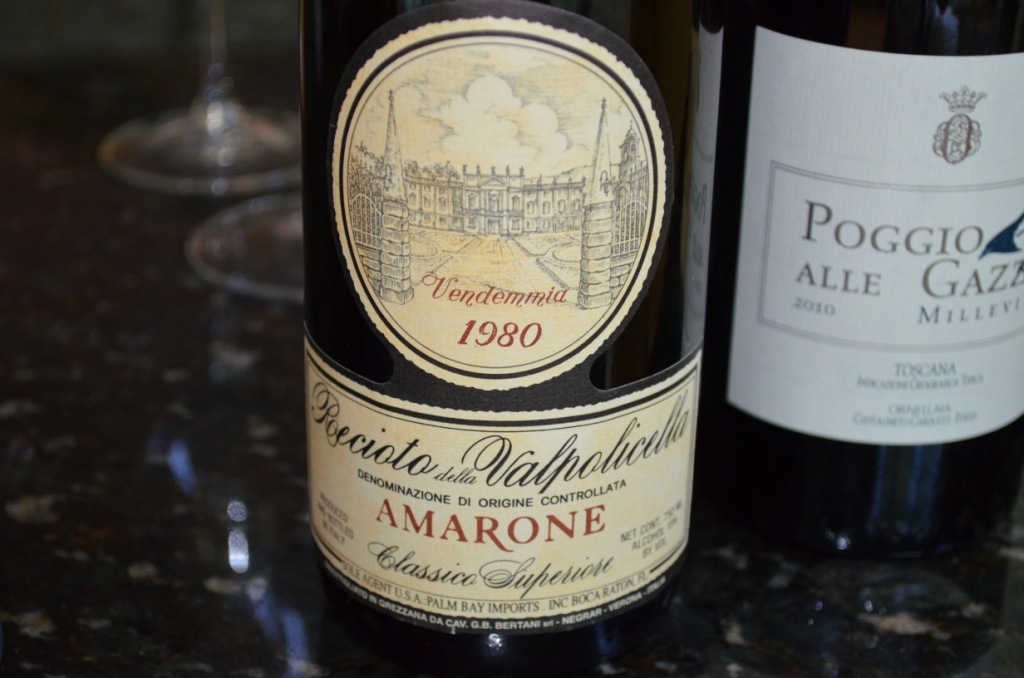
The next wine was Giribaldi Cento Uve – but this will be a subject of a separate post, so I will skip my tasting notes for that wine. And the next wine was the one … we killed – it sounds way too strong, I know – but please read on. Amarone are typically big enough wines, so we decided to decant this wine – without even tasting it first (but the nose was perfect!). This was a [big] mistake. After 3 hours in decanter, the wine became barely drinkable. Another 30 minutes later, the fruit came back, both on the palate and the nose, only to disappear shortly after. Note to self – be careful with decanting. Considering this experience, I will not give this wine any rating – it simply wouldn’t be fair.
As you might expect, we didn’t just drink – we had a lot of good food as well. Just to give you an example, here is lamb kabob in the process of making:
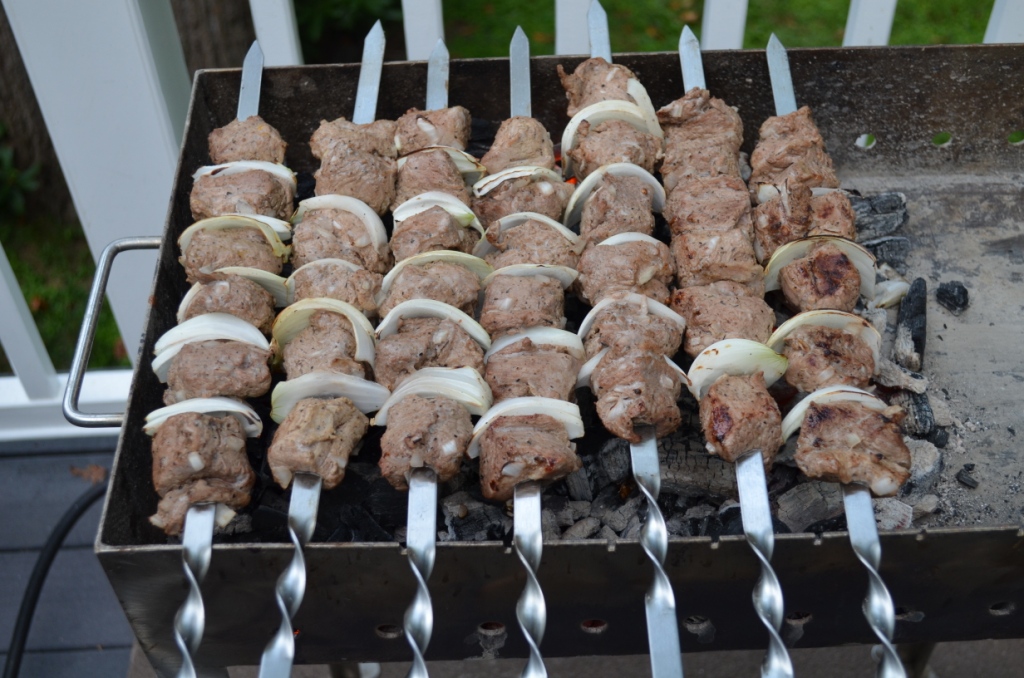
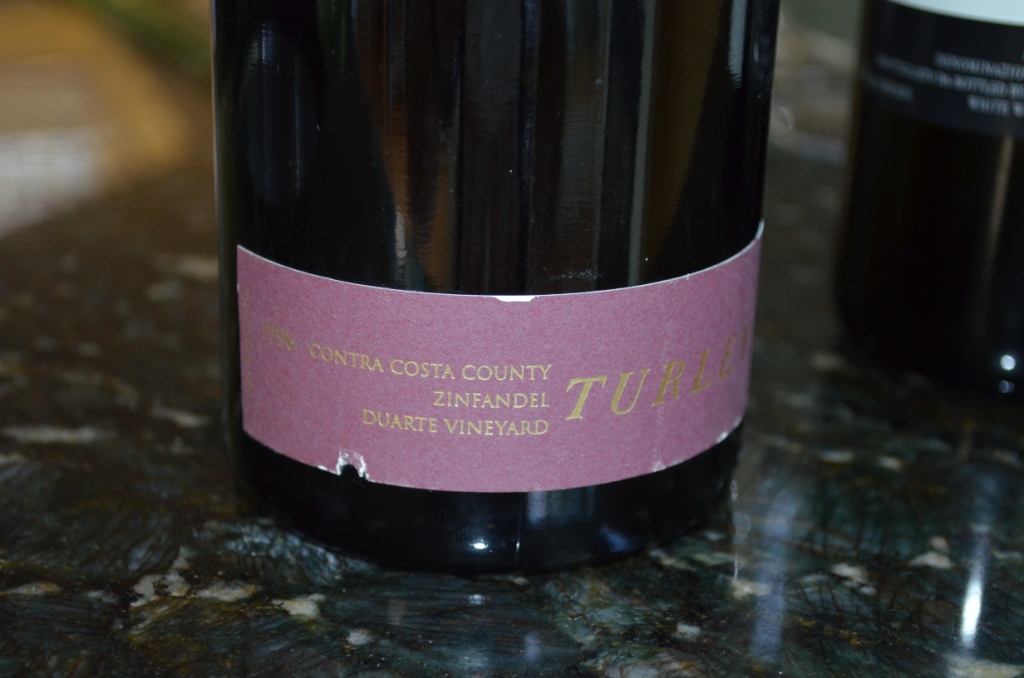
To complement the lamb, we had 1996 Turley Duarte Zinfandel – nice fruit, raspberries on the nose and the palate, hint of jammy fruit later on, plus some eucalyptus. Very good overall balance for the wine at 15.4% ABV. Drinkability: 8-
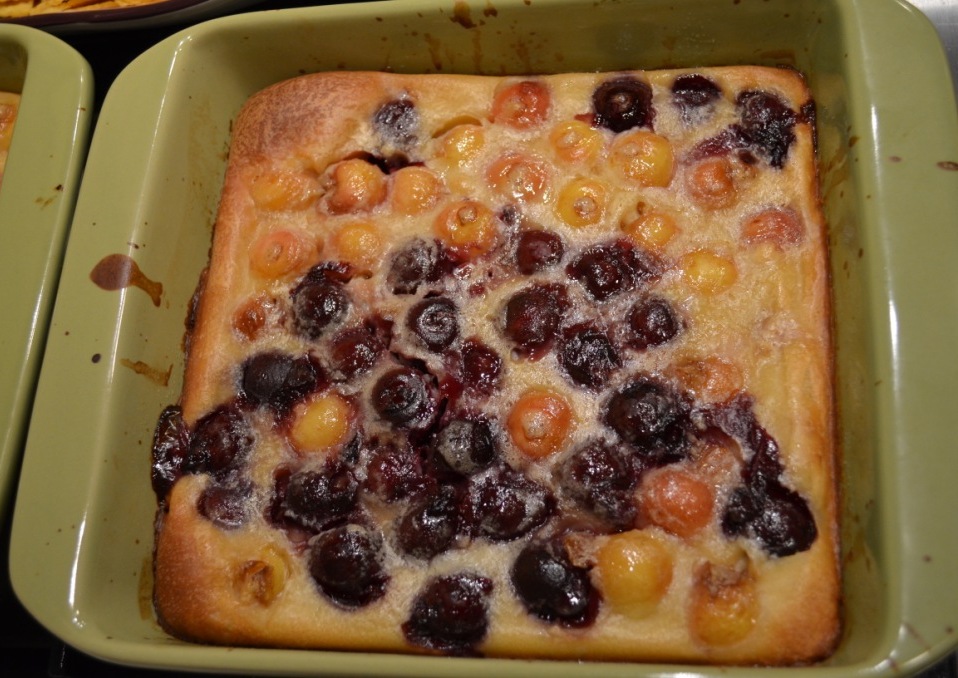
And then of course there was a dessert – Clafoutis (no further comments, just look at the picture):
This was definitely a great experience. Pretty rare case when all the wines worked very well and were absolutely delightful – if I can only re-taste that Amarone… Well, may be one day. Wishing you great wine experiences! Cheers!
Weekly Wine Quiz #21: Do You Know The King?
We had quizzes about history of the wines, we had quizzes about [big] numbers – let’s go back to the grapes and wines for now.
For today, I have a very simple question for you. We like to assign some human references to our wines. Some of them we call “the best in the world”. There is a particular Beaujolais which is considered “the most feminine” wine in Beaujolais, and then another Beaujolais wine is called “the most masculine”. And then there is a King. One of the well known wines (not a particular bottling, but the whole wine type) is often referred to as King of Wines. Do you know which wine is it?
Have a great weekend! Cheers!
Daily Glass: 2009 Chorus Effect by Field Recordings
I have a question for you. Have you ever experienced a special bottle “today is the day… or not” effect? It is when you have a bottle you want to open, but you can’t decide if today should be the day, or you need to wait a bit longer? I’m not talking about special bottle which. let’s say, bears vintage year of your son or daughter’s birthday – those are easy, you only contemplate once a year whether to open the bottle or not. I’m talking about more of an everyday, reasonably priced wine, of which, let’s say you have only one bottle, and you know that you can’t get another one – this is the case in point.
Ever since I was blown away by the bottle of Fiction by Field Recordings (here is the link to my post about that experience), I wanted to try another wine made by Andrew Jones – Chorus Effect. I had the bottle for about half a year in “to use in the near term” place, and I can’t even tell you how many times I was in the “today is the day” mood, and … nope, I guess it was not.
And somehow it happened that the day was finally today, and the bottle was open ( one easy move, you know – those screw tops are perfect for easy opening).
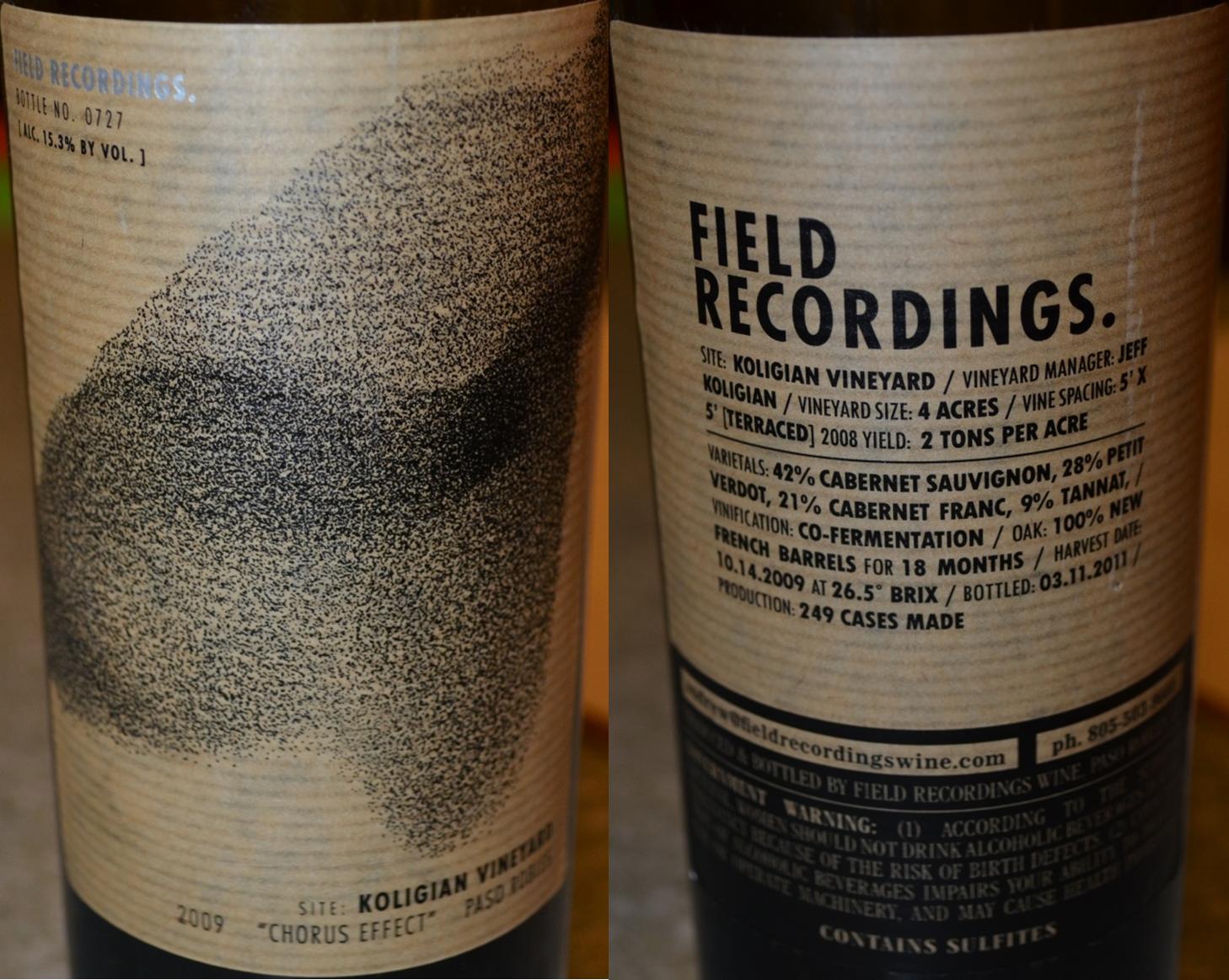
This 2009 Field Recordings Chorus Effect Koligian Vineyard, Paso Robles ($26, 15.3% ABV, 249 cases made) is a Bordeaux-style blend – you can see the exact composition on the picture of the back label.
The wine had beautiful purple color, bright and fresh. Nose was showing sweet cherries, plums and a touch of spices. But the palate… If Fiction, which I mentioned earlier, had absolutely astonishing nose, this wine had the same on the palate. This was a textbook study of a red wine, all in one sip – not the Bordeaux specifically, but the red wine overall. Sweet cherries, ripe plums, blueberries, tar, sweet vanilla, licorice, violet, chocolate, pepper, tobacco, eucalyptus – you could easily taste each and all. At the same time, the wine was balanced, with soft tannins, without any jamminess which can be often observed at such high alcohol levels. I’m not sure if I’m ready to rate it – I really want to see what will happen with this wine tomorrow – but for now, I will put the Drinkability at 8-, mainly due to the alcohol burn which was not noticeable at the beginning but showed up couple of hours after the bottle was opened.
Did you open your special bottle today? Will be glad to hear your story. Cheers!
Wine = Art
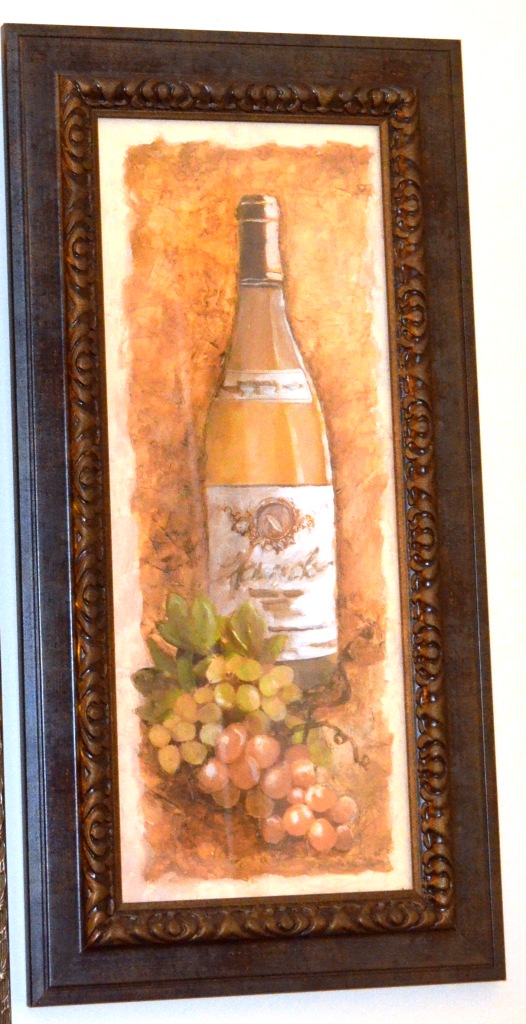 The title of this post is not misleading. I plan to talk about wine as an art form, which is the way I look at it. Why all of a sudden? Couple of articles, both great in its own right (I mentioned both in the Meritage post a week ago), prompted this blog post, despite my claim that I’m not going to enter this debate. I don’t know why is that, but I have a habit of saying “No” where deep inside, as soon as I finish my full and long “no” sentence I already know that, “oh it will be a yes”. Anyway, this blog post is not about me, it is about wine, so let’s get closer to the subject.
In case you didn’t have a chance to read those two articles, they were both on the beaten up (badly beaten up, I have to say) subject of cheap wines versus expensive wines. The first article, published in the Forbes magazine, provided a number of illustrations to the fact that…there are many factors affecting perceived taste of wine – temperature, label, feel of the moment, critics’ opinion, rating and many more (I’m not going to cite a full article here – it is well worth reading if you are into the wine world). I believe that one of the points of the article was to suggest that for the most of us, we can’t distinguish between cheap and expensive wines anyway, so why bother – drink any wine, be happy (I’m oversimplifying, I know).
Then Steve Heimoff took the subject close to his heart and went on to explain that there is a very big difference in taste between $15 and $150 bottles of Napa Valley Cabernet Sauvignon, that more expensive wine is always better than the cheap wine and that the the whole premise of Forbes article in Steve’s words is “man bites dog” attempt at a cheap publicity.
Let me take step aside and explain the meaning of the concept “wine = art”. When you are at home, take a look around you. I would make a safe assumption that for absolute majority of people, your home is decorated in one way or the other. You might have pictures and photos on the walls, statues big and small, flowers live and not, little (or big) mementos and many other things which surround our lives with only one purpose – to give us pleasure, set the mood or may be create lasting connections between time and memories. Taking pictures as the simplest example, they can be your kids’ pictures, copies of the works of the famous artists, works of the completely unknown artists or may be they are actual original paintings. Those pictures can be mass produced and acquired at the neighborhood convenience store for $4.99. But they also can be acquired after a long battle at the auction, where you had to put down $4.9 million to beat another guy and get that painting you always dreamed of.
Now, when was the last time you read an article telling you that you are not supposed to buy any works of art more expensive than $19.99, because you are not capable of understanding the difference between $19.99 and $199 pictures? Or when was the last time you read an article telling you that expensive painting is always better than cheap print? I can bet I’m giving you a very taxiing memory-combing exercise which will yield no results.
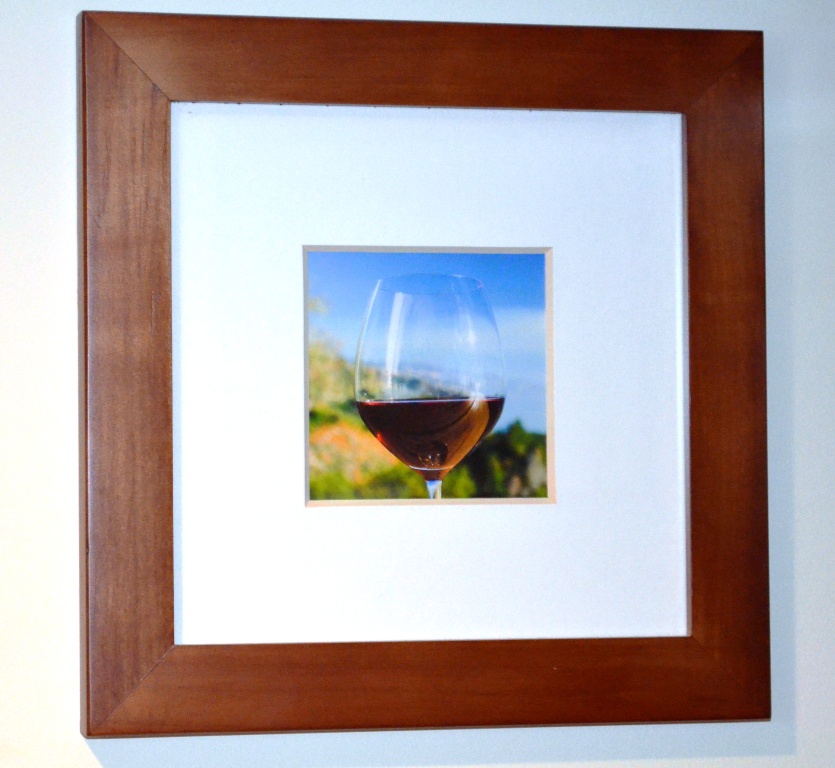 So my question is – why wine is treated in any different way than any other works of art? Read (or talk) about the wines, read about vineyards and places, read about wine makers, grape growers, oenophiles, wine collectors – what do you get out of that reading or talking? Passion, obsession, emotions, feelings. We eat because we have to, but we drink wine because we want to, because of its ability to resonate with our beings, to create emotional response. This is my premise of “wine = art” statement. I believe that wine is a form of the renewable art, which also has a pretty unique advantage compare to a simple painting, for instance. Whatever you see on the painting will be exactly the same in 10 years or in 50 years. It will create different emotions on a different day, of course – but it will not change in principal. At the same time, even the simplest wine will change in the bottle. For better or worse, but it will change. Last weekend we shared a bottle of 1997 Toasted Head Cabernet Sauvignon/Syrah blend (probably $9.99 or less) – believe it or not, but this wine was outstanding – it evolved, it had beautiful fruit, great balance and nice finish. It was memorable, it solicited emotions, it created mental staples for that particular moment. If this is not art, I don’t know what is.
Where am I going with this? I don’t believe cheap versus expensive is a meaningful or useful argument for the wine world. Yes, there are many reasons for the wine to be expensive – best quality grapes with very low yield, state of the art facilities, manual processes, need for aging before release, market demand, reputation and many many other factors define the price and can drive it very high up. But if you will exclude snobbery, arrogance and blissful ignorance, price is simply one of many factors which affect your buying decision – nothing more and nothing less. Yes, $150 bottle will taste different than $15 – but can we say “better”? If someone is a Pinot Grigio drinker (and enjoys it very much), will you be able to prove to him or her that $150 Cabernet Sauvignon is really better that $15? I want to see that happening. When it comes to wine, “better” is a difficult category, as the definition of the best wine is 100% personal – the best wine is the one which tastes best to you. Yes, critics matter, ratings matter – but only as a reference, as food for thought.
Wow, did I bore you to death? I truly hope I didn’t – I think this post was brewing for a very long time, slowly ripening to the point of wanting to get out. These are my true feelings, this is how I see the wine world, and “wine = art” makes it so fascinating for me.
Is this arguable? Of course (comments section is down below and only a click away). I don’t pretend to possess the absolute truth – but “wine = art” makes me open a bottle of wine with hope and excitement. No matter what anyone said about that bottle, how much it costs or what the rating is – I hope you will enjoy it and I hope it will create a special memory, a special moment – just for you. Cheers!
Wednesday’s Meritage
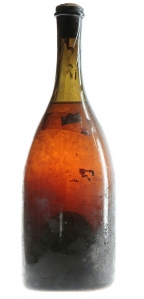
1774 Arbois ‘Vin Jaune’ ©Serge Reverchon
Brand new Wednesday is here, so is your serving of Meritage.
Let’s start with the answer for the Wine Quiz #20 – How much this wine worth to you? I believe this was a hard quiz, may be even hardest so far. I’m glad to see a full spread of answers with 5 out of 6 being picked as potential choice. Another interesting thing for me was that I had one mostly a bogus wine in that list of answers (1878 Petrus), and it was not picked up by anyone – 1878 was the year when Chateau Petrus received gold medal at Paris Exhibition, but I’m sure that it was not the vintage which got the award. Here is a quick run down for the rest of the wines: 1929 was one of the all time best vintages of DRC, so I’m sure that wine would do very well at the auction. 1873 Chateau Mouton Rothschild is the real wine which I saw in the cellar of The Forge restaurant (here is the post which has the picture of the label) – no idea how much that wine could be sold for at an auction, but I’m sure it would not be insignificant.
If you heard of “shipwreck champagne”, 1825 Veuve Clicquot is the one. It didn’t get that much money at the auction, but someone still paid a respectful €30,000 – here is a link for the you. And 1715 Terrantez Madeira might be the oldest wine in existence in the world (certainly the oldest Madeira) – here is a link for you (warning! extensive drooling might occur!).
If you noticed, I skipped 1774 ‘Vin Jaune’ – yes, you got that right – this is the wine which was actually acquired for €57,000 at the auction in France – you can read all the details here. Surprising as it is, we have to assume that it was worth it. My only question is if we will ever read the tasting notes on that wine (hmmm, I wonder how I can get invited to that tasting? yeah, not happening, I know).
In the “interesting news” department, here are few things for you. First, an interesting short post by Dr. Vino – it appears that French politician is proposing to ban California wine as a response to Foie Gras ban in California.
And then I found that two of the [professional] wine bloggers I follow, Blake Gray and Steve Heimoff, completely independently wrote about their experience with bad wines. Both posts are different and talk about different situations, but nevertheless, they both appeared in a very close timing proximity from each other. Blake Gray is talking about bad $80 California wine and arrogant winery owner, and Steve Heimoff is talking about simply a bad wine and wine critic’s dilemma. Be sure to read the comments to both posts, as they are also very interesting.
Last but not least: The finalists for the Wine Blog Awards 2012 are announced – take a look and vote!
That’s all, folks. Happy Wine Wednesday and stay cool (I had to say it). Cheers!
Last Bottle Sign Up ($10 credit)




 Talk-A-Vino