Archive
Canada Food and Wine Experiences, In Pictures
It appears to be very difficult to write blog posts while on the family vacation, despite all the desire to do so. Therefore, here is a quick report from Canada – all in pictures. I can tell you that so far I had being very happy with food, including restaurants in Niagara Falls (which was not expected considering that this is very popular tourist destination). I was also blown away by the quality of Canadian wine. Before the trip, I honestly thought that outside of the Icewine, Canadian wine would be on the level of Finger Lakes wines in NY, where whites can be drinkable, but reds are simply mediocre. Boy, was I wrong! We visited three wineries, and didn’t have a single bad wine! Well, this will be a subject of a separate blog post, so for now, here is quick report in pictures (warning – don’t look while hungry).
Nachos at Spicy Olive restaurant, Niagara Falls:

Beef Baron restaurant, Niagara Falls:
French Onion Soup:

Escargot:

Spare Ribs:

Wineries experience:
Inniskillin (from whites to reds to Icewines – outstanding, will discuss later):

Inniskillin Cabernet Sauvignon/Syrah and Cabernet Franc – WOW:
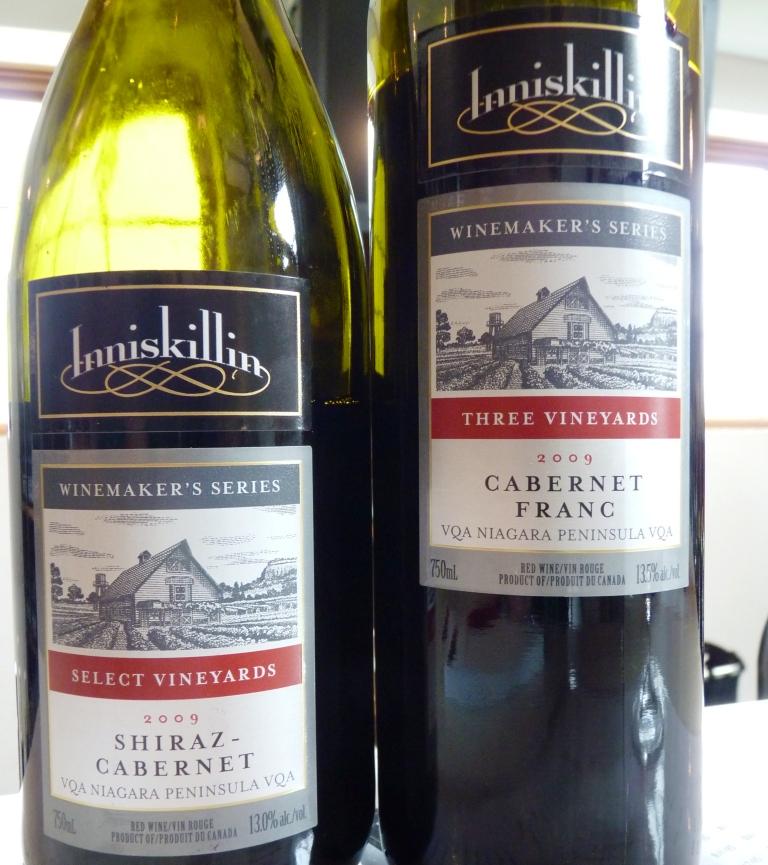
Inniskillin for those who can’t even drink wine:

Cattail Creek Winery, very interesting whites and reds:
Catastrophe series (note that labels depict real cats):

Chateau des Charmes – you should see that building:

Back to the restaurants:
Cora’s (Niagara Falls) – Breakfast done right!
Breakfast cocktail:

Crepes Egg and Cheese Panini:
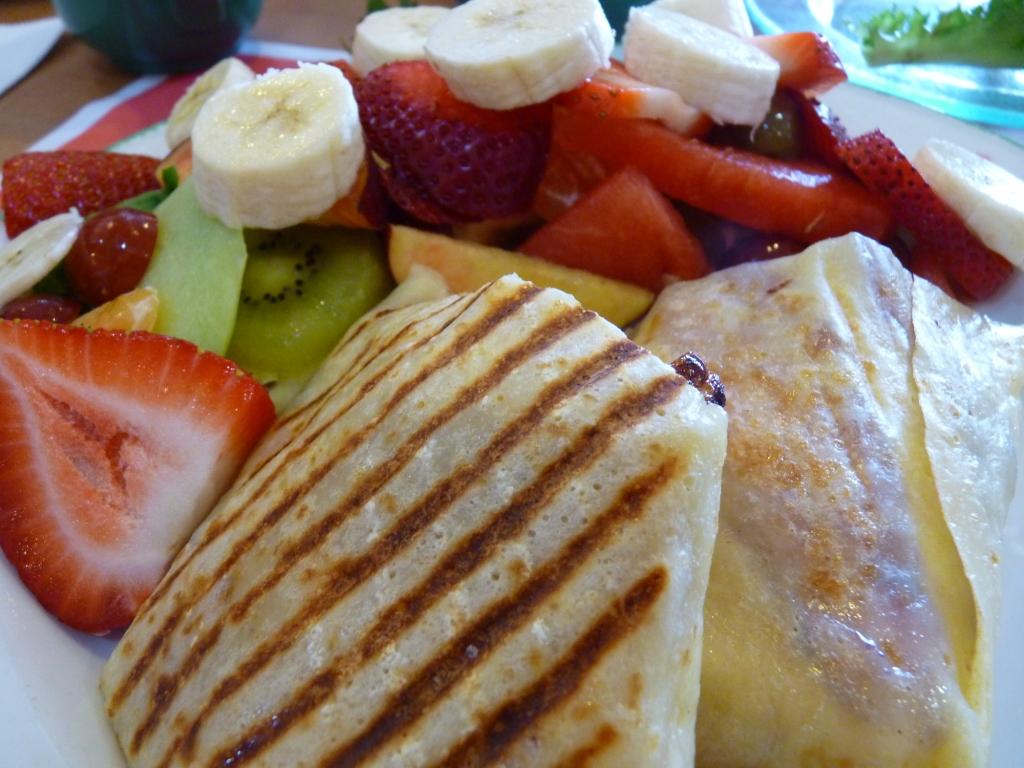
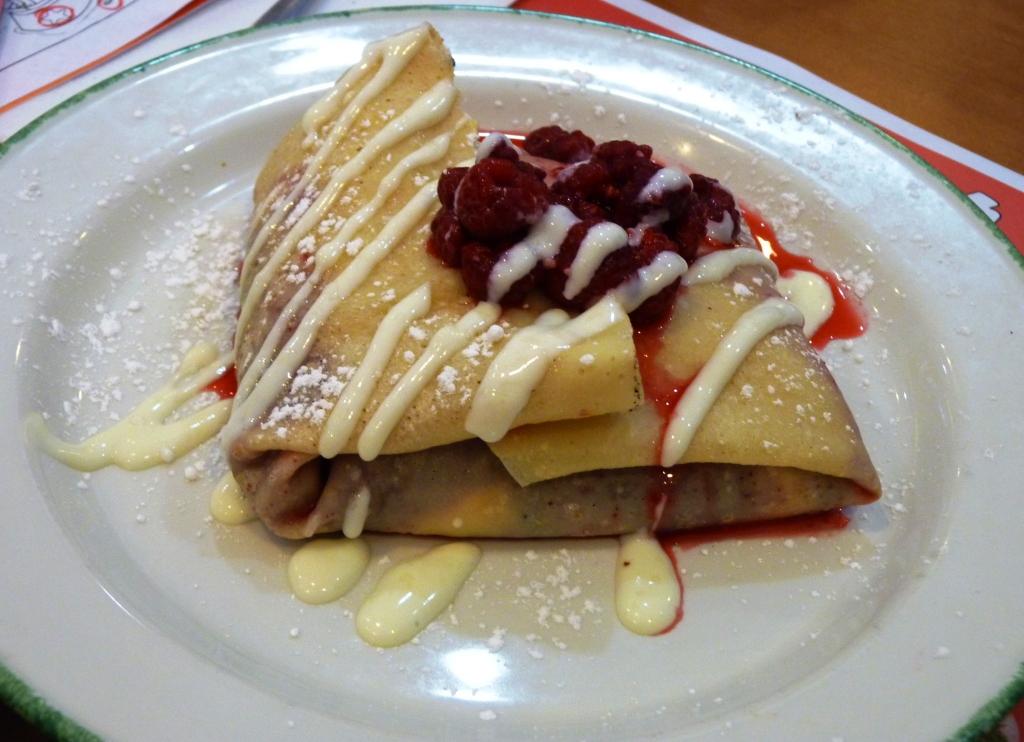
Crepe with Raspberries and cream cheese:
Blueberry Pancakes:

Will definitely talk more about wines in the future posts. If you are interested in reading more about restaurants, you can take a look at my page on Yelp (click here). Until the next time – cheers!
Cora
7555 Montrose Road
Niagara Falls, ON L2H3A4
(905) 358-1555
http://www.chezcora.com/home

What Do You Drink When Weather Is Like This?
This heat is literally paralyzing…

Is there anything to drink besides water?
Here is one possible answer:

So, what do you drink?
Scotch Experiences – Talisker, Hello from Oregon, and Something to Dream About
 As you probably know, scotch is my second favorite drink, right after the wine. When it comes to scotch, I pretty much like all of them, with a slight bias toward the smoky style. One of the most unique smoky whiskies is Talisker (one of my favorites), which has a unique, almost medicinal nose full of smoke, in addition to lots of smoke on the palate (it is different from traditional Islay whiskies which have very expressed smokiness on the palate, but not as much on the nose).
When my friend Zak said “you have to try this” and pointed to the bottle of Whiskey, I couldn’t believe it – single malt whisky … from Oregon? What is happening? Well, tasting is believing (seeing is not enough) – and when I tried this McCarthy’s Single Malt Whiskey I was literally blown away. While this whiskey is compared to Lagavulin (probably the most classic Islay scotch) on the producer’s website, my first impression was Talisker. I’m quite convinced that in a blind tasting I would confuse this whiskey for Talisker, both from the smell and the taste ( this probably shows my weak side, but I will live with it). On the nose, this whiskey exhibited the same medicinal smoky flavor, with lots of smoke following on the palate, with expressed minerality and perfect balancing acidity – this scotch was literally refreshing, if scotch can be considered a refreshing drink. At $49.99 at Cost Less Wines and Liquors, I think it is a great deal – if you like smoky peaty scotch, don’t miss it.
And then as I was leaving the store, I spotted this bottle of 1979 Glenrothes…

‘Nuf said… Until the next time – cheers!
Counting Grapes
 Among many good wines of recent (yeah, I’m really behind in my writing) there were few of new grape encounters which I want to share with you. First is 2004 Ambasciatore Friularo Bagnoli DOC, made out of the grape called Friularo. I have to tell you that I actually have one problem with this wine – it is not available in US (if you know otherwise – please let me know), and I brought only one bottle from Switzerland (it is an Italian wine which I got in a supermarket in Geneva). This wine was beautiful, layered and powerful, very balanced, with great amount of dark red fruit, all complemented by great acidity and good tannins. This wine would age perfectly, so quick expedition to Geneva or any other place where this wine can be found, sounds like a good idea.
Next three wines were also very good – and they are all available in US, plus all three would be perfect for the summer day, so you can also expand your wine horizon and have good wines at the same time. Starting with the white, 2009 Petite Burja Vipavska Dolina from Slovenia was very nice and unusual – good acidity and sweet herbs on the palate. This wine didn’t have any pronounced sweet fruit notes, but instead it had well defined sweet herbs, may be cucumber-sweet. Very easy to drink. I have to note that this wine also sports one of the most unusual labels I ever saw – it seems that the winemaker had a problem with the getting the modern printer, and had to use a very old one, incapable of producing any graphics (or may be wine maker also used to be a computer engineer, who knows…).
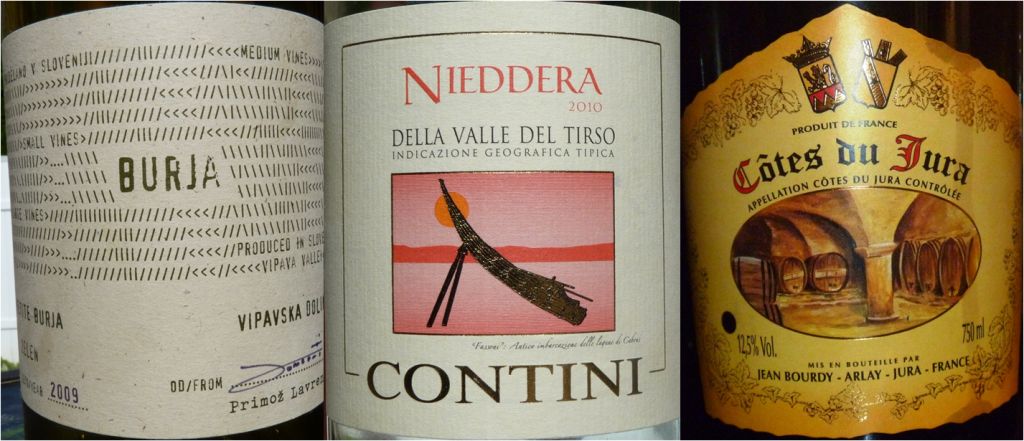
Moving from White to Rose, the next wine is 2010 Contini Nieddera della Valle del Turso IGT – nice and light, with medium body, good refreshing acidity, showing notes of cranberry – very good wine for a hot summer day. Nieddera actually is a local grape which was used for production of this wine.
Last but not least is 2006 Jean Bourdy Cotes du Jura Rouge, which is made out of three gapes – Poulsard, Trousseau and Pinot Noir (Trousseau is a new grape). This is a bio-dynamic wine, and it is very unusual in its flavor profile – but it is light enough to be enjoyed during summer (as soon as you will train your palate a bit on bio-dynamic wines – I will explain myself in one of the future posts very soon).
Four new grapes, four very interesting wines – very happy with this journey so far. Try to find them and experience for yourself – I’m sure you will not regret. Cheers!
Wine, Aged Beautifully
 Let’s talk about aging. No, that’s not what you think – not people aging and not the world problems with the aging populations. Let’s talk about the aging of the wine. By the way, it appears that second time in the row I’m taking upon the popular subject – in the previous post we were comparing the wine glasses (post can be found here), and now the wine aging.
With all due respect (based on this phrase, my friend Kfir would tell you right away that I’m about to blast something), I completely disagree with the majority of the popular opinion on the subject of wine aging. Open a wine book, read a wine blog, or ask a question on Quora, and for the most part, you will get an answer that 95% of the wines are not supposed to be aged and should be consumed within a year or two from the release date.
Based on my personal experience, I disagree with this viewpoint. I can’t put a percentage or a quantity on it, but I believe that well in excess of half of the wines produced in the world (not by the volume, but by the variety of the actual wines) can age very well for 5 to 10 years – and “age well” means “to improve with age”. My biggest problem with the aging of the wines is … space. If you want to drink aged wine, you either need a lot of space, or you need [typically] lots of money, as most of the aged wines increase in price. If you have a cool and dark area with constant humidity, you can buy wines as they are released. store them and enjoy them later as they evolve and mature. Otherwise, you need to have money and a reputable source of the aged wines (improper storage conditions will ruin any wine in no time). Once you solved your space problem, the rest is easy.
How easy is that? How can we know if that bottle of wine will age well – read: improve with age? There are way too many factors affecting the aging of the wine, and being able to predict age-worthiness of the wine (age-worthiness means that wine will evolve and taste better in the future) is more art than science. As an example, Matt Kramer, one of my favorite wine writers identifies age-worthy wines using characteristic of the mouth-feel, a mid-palate weight of the wine in the mouth. Here is my take on the subject. First, yes, of course, some of the wines are meant to be aged – for instance, Beaujolais Noveau is released in November and should be consumed by May of next year. Outside of the wines which are designated by winemakers as “do not age”, the majority has some aging potential. I believe the biggest dependency here is on the winemaker and what she or he wants to achieve with particular wine – if wine is well made, there is a good chance that it will also age well.
Some wines are helped by their “DNA” – under which I mean from what grape and where in the world the wine is made (of course good/bad year matters too). California Cabernet Sauvignon expected to [typically] reach maturity at around 13 years. Bordeaux easily ages for 30-50 years. Syrah-based wines, whether from Australia or France, can live for 50 years. Many 50-years old Riojas are fresh and vibrant as being just made. But “DNA” alone is not enough – wine should be well made in order to age well.
If you are still reading this post, I guess you might be tired by now by this prolonged escapade into the wine aging, and you might be wondering why, why is all that wine aging might be important? Well, I can’t answer this question. At least not before you will find the wine with a little age on it, which will blow you away. Yes, it is an acquired taste. But once you will actually acquire that “mature wine” taste, this is what you are going to crave, I guarantee you.
 Let me share some recent and exciting discoveries. Let’s start with 1995 Flora Springs Chardonnay Napa Valley. This wine is made out of 100% Chardonnay. While the nose was not very expressive, the level of complexity of this wine is unimaginable. Yes, considering dark golden color, this wine might well be past prime, and without that “acquired taste” for the aged white wine, you might be even upset after the first sip. This wine was exhibiting notes of vanilla which almost moved up to some sort of the almond paste, still showing some acidity. Next are savory notes, almost to the level of saltiness, which was increasing the complexity even further. The wine was in a very stable shape as it tasted the same on the second day as well. Will this wine evolve further? Who knows – but I would be very happy to taste this wine again in five or maybe ten years. Drinkability: 8
 The next wine is 1992 Domaine de Thalabert Crozes-Hermitage from France. Crozes-Hermitage wines are made primarily out of Syrah, typically with a very small addition of Marsanne and Rousanne grapes. As we mentioned before, Syrah wines age quite well, and this was an excellent example of the well-aged Syrah wine. This wine was very playful and soft, with lots of red fruit on the nose and on the palate, very good acidity and a good level of tannins. This wine probably will continue evolving for the next five to ten years, and again I will be glad to help you share the bottle later on – if you will have one. Drinkability: 8-
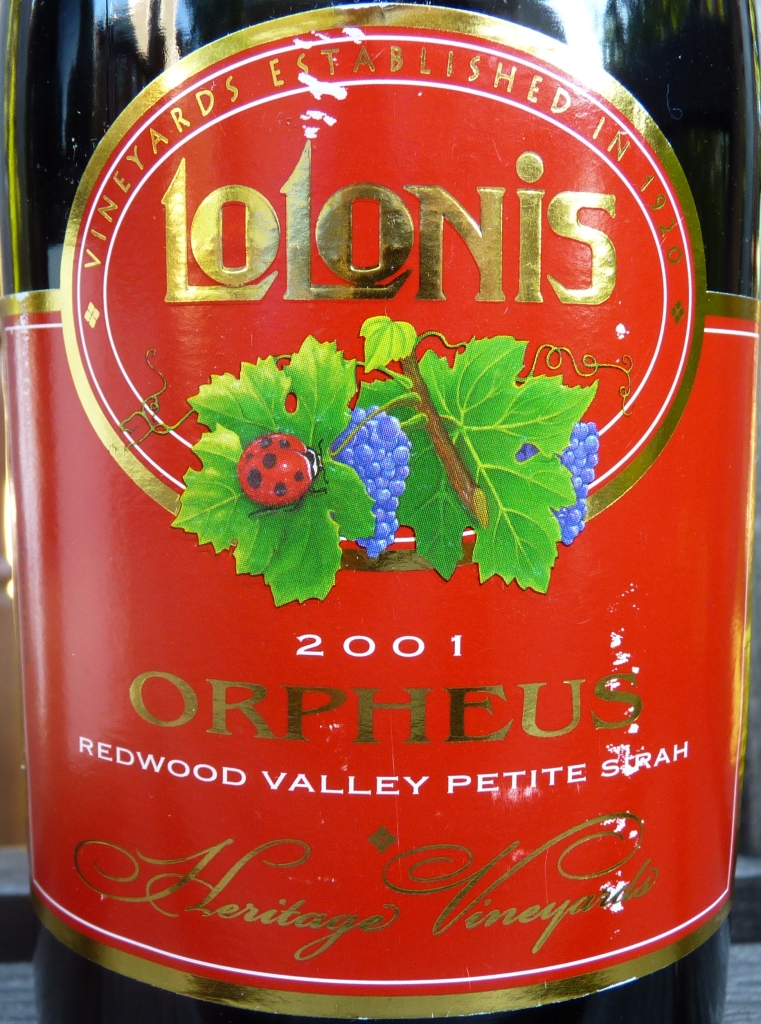 Going back to California, 2001 Lolonis Petite Sirah Redwood Valley. In short – outstanding. This 10 years old wine was completely fresh and beautiful. It is made from organically grown Petite Sirah grape. The wine showed perfect dark fruit, good acidity, full body, excellent tannins, and perfect overall balance. This wine might be evolving for the next 10-20 years – again, the trick will be to find it.
Drinkability: 8+.
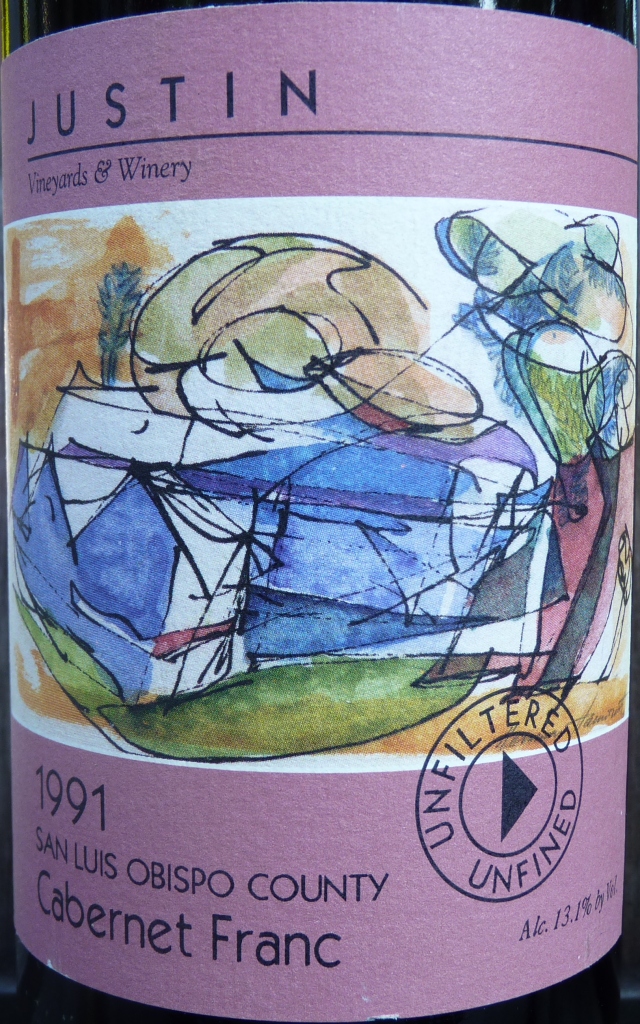
Last, but not least, 1991 Justin Cabernet Franc, San Luis Obispo County. This was the “wow” wine, that exact mind-blowing one. First, while I like Cabernet Franc wines, I had no idea they can age so well. I can literally guarantee that in the blind tasting format, very very few people would be able to guess the age of this wine. Deep garnet color, not a hint of age (no brownish overtones at all). Perfect fresh fruit, soft and luscious, a perfect balance of tannins and acidity. This wine was the oldest in the tasting, and it was definitely the best of tasting. Considering how good it was now, I can’t even guess how much time it has left – but I would be very glad to find a few more bottles to be “wowed” again in the future. Drinkability: 9-
One note before we conclude – this was a rare case of someone doing all the hard work, and me enjoying the results – I got all wines from Benchmark Wine Company and each one of them had been less than $20.
Don’t know if you got the desire to seek well-aged wines – I hope you will one day. For now, I can only wish upon myself, my family, all my friends and all of you, my readers, to age as beautifully as this Justin Cabernet Franc does. Cheers!
War Of The Glasses: Does Wine Glass Matters?
 Of course the topic of wine glasses and their effect on wine’s perceived quality (which includes smell, taste and overall pleasure) is a very popular subject among wine lovers (professionals are also not immune to such discussions). I have no intention to claim any original or unique thoughts on the subject – instead, I want to merely report on my own personal experiment.
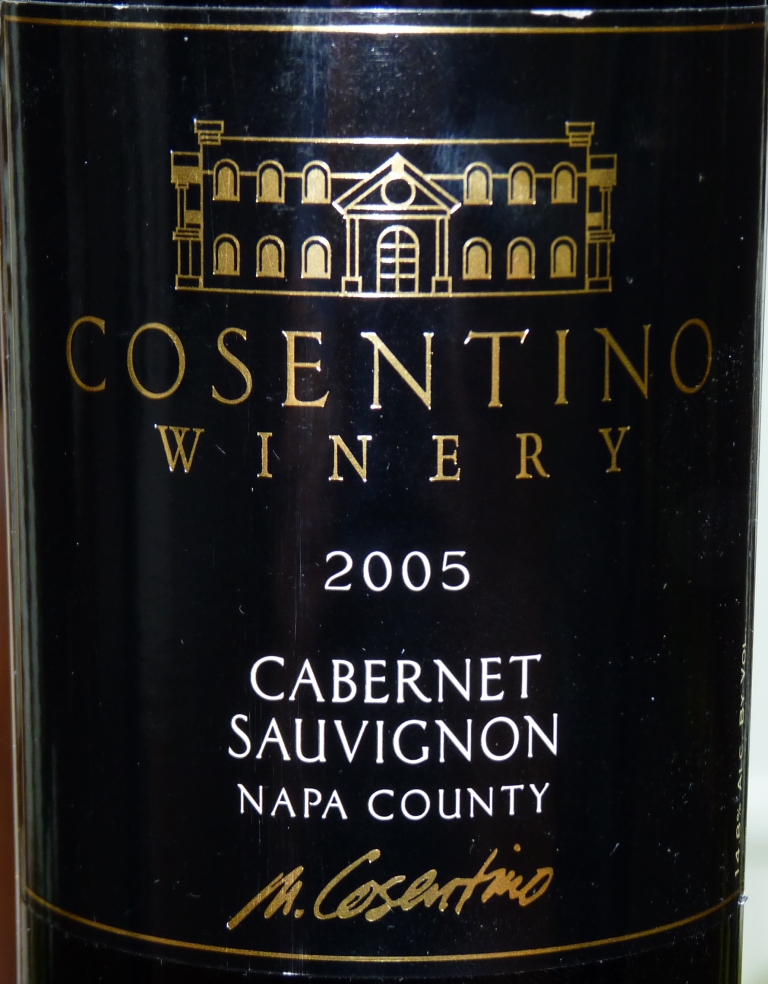
We started with 6 different glasses and a bottle of wine. For this experiment, I wanted to use a wine with classic flavor profile, nothing too obscure – seems that Cabernet Sauvignon would ideally fit the bill. I can tell you now that I was moderately happy with the choice of wine. While I like Cosentino wines, this 2005 Cosentino Napa Valley Cabernet Sauvignon was more fruit forward than I appreciate, but still it was not a very bad choice.
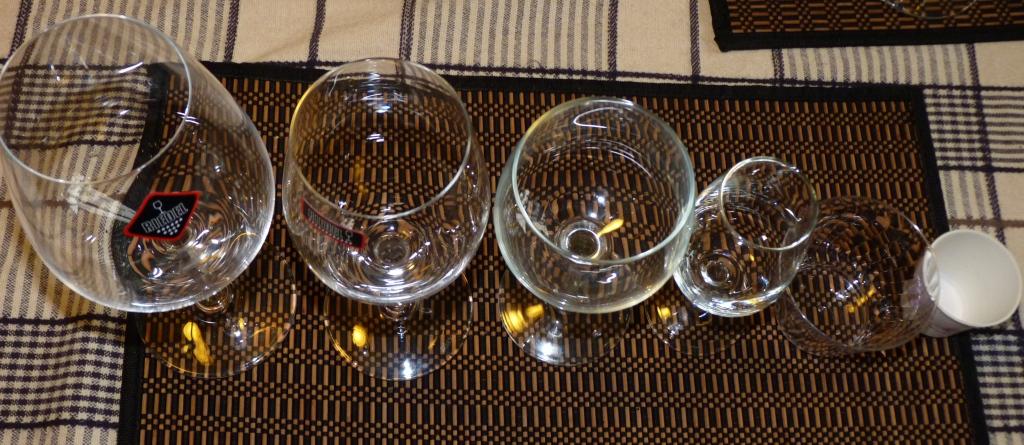
The glasses included: Riedel Cabernet Sauvignon Glass, Riedel Universal tasting (also can be called “restaurant special”, 489 0 in Riedel nomenclature) glass (holds 20 oz), a wide open, almost “square” glass (don’t know if it has a special name), small (8 oz) universal tasting glass, plastic cup and small paper cup.
Now for the notes (results are presented in the exact succession as glasses were assessed):
Riedel Cabernet Glass:
Nose: big concentration, noticeable alcohol, smell of a wet dog (must be something wrong with me)
Palate: lots of fruit, black currant, still quite sharp
Riedel Universal (489 0):
Nose: good concentration of the fruit, alcohol is less noticeable
Palate: very good fruit, round taste
“Square” glass:
Nose: some fruit are a bit more open (black currant), overall less alcohol, less fruit concentration.
Palate: taste is ok, a bit less of everything
Small universal tasting glass (8 oz):
Nose: almost like previous one, noticeable fruit
Palate: the softest of all! Nice round fruit
Plastic cup:
Nose: literally nothing
Palate: ok, similar to the one above
Paper cup:
Nose: none
Palate: bad
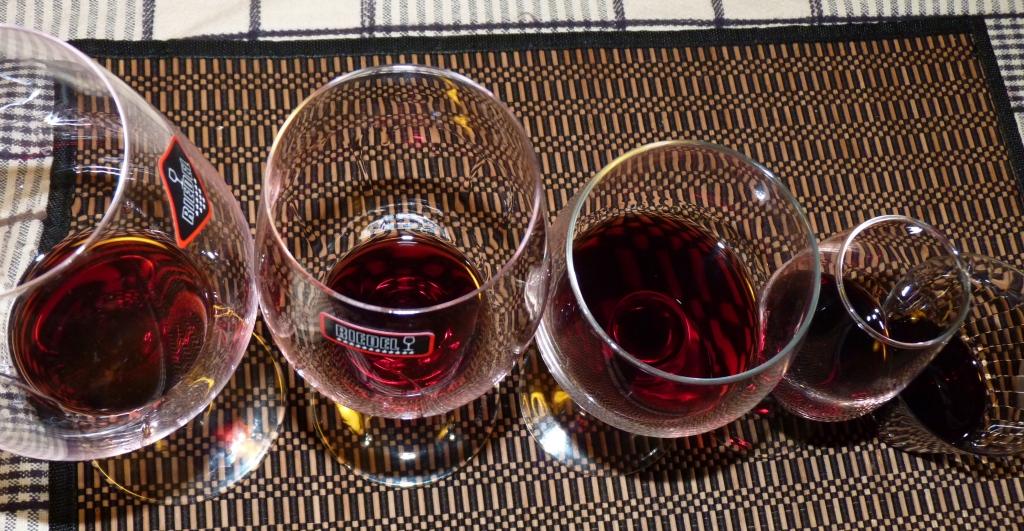
Let’s try to come up with some conclusions now. I think two universal tasting glasses fared the best – size difference didn’t matter. Of course bigger glass was more convenient to use, but outside of aesthetics of wine appearance in a bigger glass, they delivered literally the same flavor and taste. We can also safely say that paper cups shouldn’t be used if you are drinking wine to enjoy it (that was a definite looser). Plastic cup can be used, but you will lose the pleasure of the smell, so if you can avoid it, then avoid it. “Square” glass was okay, but again you will be losing on the aroma details. Lastly, Riedel Cabernet glass still requires more experiments. It was definitely not the best glass in this tasting, but I believe that it might enhance the taste of some particular Cabernet wine, most likely less alcohol, old-world style wine, where it will actually be able to enhance subtle aromas and flavors.
For now, don’t drink your wine from the paper cups, and save the money by avoiding those super-expensive “specialty” glasses, and you will do quite well. And if you have an opinion (different one? even better!) – leave a comment, and let’s have a debate. Cheers!
Daily Glass: Martinet Menut
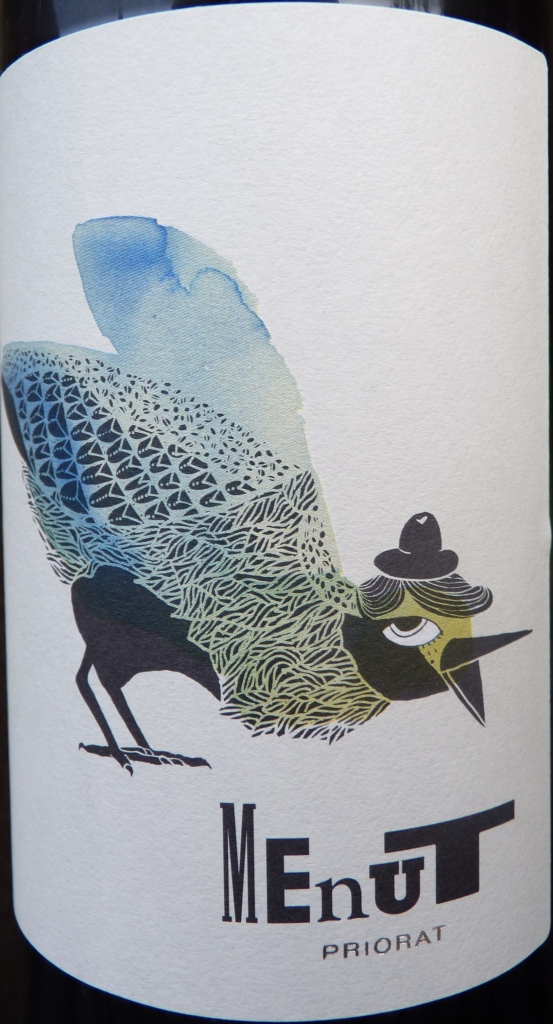 Looking for the bottle to open (this is not ready, not tonight, don’t feel like it,…) I stumbled upon a bottle with the bird picture on the label. Okay, I have no idea how this might taste, never tried that before, don’t know what grape(s) it is made out of – yes, that looks like the right bottle to open.
Cork popped out, and the wine goes in the glass. Energetic swirl (exactly as taught by Kevin Zraly, without covering glass with the hand), sniff and… I couldn’t extort anything beyond sacramental “WOW”… It was a true sensory sensation – the wine had perfect vinous nose, with absolutely everything you want to find in glass of red wine – the fruit, the vineyard, spices, earth, terroir, mystery…
On the palate, it had lots of dark red fruit – plums and cherries, all coupled with good acidity and tannins. Of course, after being blown away so much, I had to check what is it I am actually drinking. This 2007 Martinet Menut is a red wine blend from Priorat region in Spain. I have to tell you – even today, in the age of Internet, there are still plenty of things which are difficult to find. Finding information about this Martinet Menut wine, as well as producer ( supposedly, Clos Martinet, one of the “cult” Priorat wineries) was very challenging. The wine apparently is Grenache-based blend, but this is about all information I’m sure at, so let’s leave it like this. This 2007 Martinet Menut can actually be compared with Clos Mogador I tasted at the Spanish Wine Festival (you can find post here) – definitely in the amount of pleasure one can get from a glass of wine. Drinkability: 8.
You think I got too excited? Always possible, so you’ll be the judge. Get the bottle, and lets compare the notes. Cheers!
Last Bottle Sign Up ($10 credit)




 Talk-A-Vino